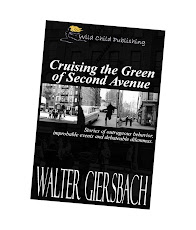
I had one of those Proustian moments last week when The New York Times ran a story on preservation efforts in the Lower East Side of the city. Happily, they didn’t call it the “East Village,” named when the hippies left and the kids moved in using Dad’s credit card. The story included a photo of Gems Spa at the southwest corner of Second Avenue and St. Mark’s Place in 1969. That might even be me — if you squinted — standing at the window waiting for my egg cream.
Marcel Proust immortalized the past in his recherche du temps perdu. I wrote Cruising the Green of Second Avenue to fictionalize those golden moments in 1969. In “Big Willa and a Push Toward the Edge,” published in Lunch Hour Stories shortly before the book came out, I relied on my memory to describe that “The long, sun-drenched evenings usually started with a group of us sitting on a stoop drinking beer. Maybe we’d go up to a bar. Then someone would suggest walking over to Second Avenue to get a bialy smothered in cream cheese and onions and pickled herring. Saturdays, there were demonstrations and protests to watch, but no one got involved. It was too hot, and carrying a placard was depersonalizing. Our Tar Beach was the rooftop on East Sixth Street. We'd wait until after sundown for a breath of air floating up from the river, and then, if we were lucky, we'd listen to the sounds of Country Joe and the Fish or the Fugs playing a free concert a block away in Tompkins Square. Always, there was the sound of drums echoing down the street.”
Who were the Fugs? A garage band without a garage, participants in the Peace Eye Bookstore, attendees in exorcising the Pentagon, and players of a certain amount of unexpurgated musical diarrhea. It didn’t matter what kind of diarrhea back then if you were stoned and the concert was free. For three decades I’d squirreled away a mimeographed copy of The Fugs’ song book, a treasure of the past.
Same week as the preservation story appeared in the Times a note also reported that Ed Sanders, leader of The Fugs, had written a new book. Lunch Hour Stories is out of business, but Ed’s still alive. The Fugs song book also has been preserved in the archives of the U. of Connecticut’s Babbidge Library, along with the underground comix I donated.
Time rolls on, but some things get caught in an eddy of the river. They’re preserved the way Carl Gossett’s 1969 photo of Gems Spa has been filed in the Times’ morgue. Ed is still playing with his group (http://www.thefugs.com/), whom the Voice’s Robert Christgau called “the Lower East Side’s first true underground band.”
At the conclusion of “Big Willa,” Jake says, “Willa had asked the universal question—‘You gotta hope, else, what’s left?’ And she was right. But I wish it were easier to believe in miracles and magic. That the dead will come back to life and long-lost lovers will be reunited. Instead, we go to the movies. We cheer Peter Pan. We click our heels together and bring Dorothy back to Kansas. I didn’t tell Willa that the Donnas come and go, illuminating us with a hot, bright light until they disappear into places like Atlanta. The Carolyns hit town as comic relief, and then they’re gone, too.”
If this teaser sounds interesting, send me an e-mail and I’ll send you a copy of “Big Willa.” You can also buy a download of Cruising the Green of Second Avenue at Barnes & Noble or other online retailers. And stop by Gems Spa for an egg cream.
Tuesday, January 24, 2012
Friday, December 30, 2011
Thumbnail Reviews for 2011
I review books feeling like the guy who says, “I know you’re really going to like [insert title or author].” Well, dammit, I like the books and want others to share my happiness! The reviews have gone up on Amazon and B&N, and on Roberta Stuhr’s site, Favorite Books and Book Review (http://philadelphiabookreview.blogspot.com/).
Here, then are seven thumbnail reviews of 2011 that were published in Book Editor Anne Bendheim's "Tell Us What You're Reading" column in the Asbury Park Press:
Fur-Face by Jon Gibb is an e-book for young adults that will also fascinate older adults. A young boy, a newcomer to the English countryside is confronted by a talking cat, who — like his friend Razor the fox — has been part of a mind control program. Challenges confronting him include a secret deal with Russians, concerned parents, nefarious scientists, and secret tunnels under the animal park. And a budding infatuation with a young girl.
Pirate Latitudes was a manuscript discovered after Michael Crichton died in 2008. It’s a rousing good page-turner in the tradition of Treasure Island and Pirates of the Caribbean. Capt. Hunter is technically a privateer who learns a Spanish galleon filled with treasure is being repaired in a fortified harbor. He assembles a crew with the Governor’s blessing to hijack it. Along the way, all of the mishaps and conquests possible — shipwrecks, imprisonment as a pirate, battles —confront Hunter and his misbegotten crew.
Who knew my favorite meteorologist is also a writer of whodunits? The Morning Show Murders, first of Roker’s three published novels, concerns the death of Billy Blessing’s TV show producer who’s been poisoned by food from Blessing’s restaurant. Worse yet, the Manhattan DA closes Blessing’s restaurant and the new exec suspends Blessing from the Morning Show. Blessing has to become a sleuth to find the murderer. It’s a rollicking, fast-paced mystery, filled with New York’s sights, sounds and personalities. Follow up this one with “The Midnight Show Murders” and “The Talk Show Murders.”
Fascinated by Caleb Carr’s treatment of 19th century forensic psychiatry in The Alienists and Angel of Darkness, I continue to search out this author. In The Italian Secretary, Carr takes Sherlock Holmes and Watson to Scotland. A pair of murders at a castle being restored leads Holmes to suspect Queen Victoria is next, her demise orchestrated by the German Kaiser, Scottish nationalists—or even the ghost associated with Mary, Queen of Scots.
With Mexico’s drug battles in today’s news, Arturo Pérez-Reverte gives us a literary backstory to a Latina who becomes The Queen of the South. Theresa, girlfriend of a narco pilot, gets a call warning that if this special phone ever rings, he’s dead and the narcos are coming for her. Theresa flees to Spain, surviving over the next 12 years by building one of the biggest drug rings in the Mediterranean. She’s one tough woman in a man’s world, and you have to love even the bad guys.
John le Carre’s A Most Wanted Man follows a Turkish Muslim boxer who unknowingly takes in a medical student. The book shows us the post 9/11 rivalries of spy agencies in three countries as we learn the student is actually the terrorist son of a Red Army colonel with a mysterious bank account. This may be le Carre’s best work — and most humanistic. John le Carre is a “must-read” author.
Dennis Lehane delivers horrifying insights into 1918 Boston with The Given Day. After the Great War and influenza epidemic, but before the ‘20s began roaring, police officer Danny Coughlin has to contend with leading a strike, mayhem from his policeman godfather, anarchist terror, and unrequited love for the Coughlin family maid. Lehane, author of “Mystic River,” has written a terrifying novel of Boston’s large-scale rioting, families torn asunder by pride, Bolshevik bombers, and wanton murders.
I know you’re really gonna like them.
Here, then are seven thumbnail reviews of 2011 that were published in Book Editor Anne Bendheim's "Tell Us What You're Reading" column in the Asbury Park Press:
Fur-Face by Jon Gibb is an e-book for young adults that will also fascinate older adults. A young boy, a newcomer to the English countryside is confronted by a talking cat, who — like his friend Razor the fox — has been part of a mind control program. Challenges confronting him include a secret deal with Russians, concerned parents, nefarious scientists, and secret tunnels under the animal park. And a budding infatuation with a young girl.
Pirate Latitudes was a manuscript discovered after Michael Crichton died in 2008. It’s a rousing good page-turner in the tradition of Treasure Island and Pirates of the Caribbean. Capt. Hunter is technically a privateer who learns a Spanish galleon filled with treasure is being repaired in a fortified harbor. He assembles a crew with the Governor’s blessing to hijack it. Along the way, all of the mishaps and conquests possible — shipwrecks, imprisonment as a pirate, battles —confront Hunter and his misbegotten crew.
Who knew my favorite meteorologist is also a writer of whodunits? The Morning Show Murders, first of Roker’s three published novels, concerns the death of Billy Blessing’s TV show producer who’s been poisoned by food from Blessing’s restaurant. Worse yet, the Manhattan DA closes Blessing’s restaurant and the new exec suspends Blessing from the Morning Show. Blessing has to become a sleuth to find the murderer. It’s a rollicking, fast-paced mystery, filled with New York’s sights, sounds and personalities. Follow up this one with “The Midnight Show Murders” and “The Talk Show Murders.”
Fascinated by Caleb Carr’s treatment of 19th century forensic psychiatry in The Alienists and Angel of Darkness, I continue to search out this author. In The Italian Secretary, Carr takes Sherlock Holmes and Watson to Scotland. A pair of murders at a castle being restored leads Holmes to suspect Queen Victoria is next, her demise orchestrated by the German Kaiser, Scottish nationalists—or even the ghost associated with Mary, Queen of Scots.
With Mexico’s drug battles in today’s news, Arturo Pérez-Reverte gives us a literary backstory to a Latina who becomes The Queen of the South. Theresa, girlfriend of a narco pilot, gets a call warning that if this special phone ever rings, he’s dead and the narcos are coming for her. Theresa flees to Spain, surviving over the next 12 years by building one of the biggest drug rings in the Mediterranean. She’s one tough woman in a man’s world, and you have to love even the bad guys.
John le Carre’s A Most Wanted Man follows a Turkish Muslim boxer who unknowingly takes in a medical student. The book shows us the post 9/11 rivalries of spy agencies in three countries as we learn the student is actually the terrorist son of a Red Army colonel with a mysterious bank account. This may be le Carre’s best work — and most humanistic. John le Carre is a “must-read” author.
Dennis Lehane delivers horrifying insights into 1918 Boston with The Given Day. After the Great War and influenza epidemic, but before the ‘20s began roaring, police officer Danny Coughlin has to contend with leading a strike, mayhem from his policeman godfather, anarchist terror, and unrequited love for the Coughlin family maid. Lehane, author of “Mystic River,” has written a terrifying novel of Boston’s large-scale rioting, families torn asunder by pride, Bolshevik bombers, and wanton murders.
I know you’re really gonna like them.
Thursday, December 22, 2011
Fool Me Once, Shame on You
Now I’m mad! Barnes & Noble rejected my review of Thomas Matthews novel, Rejection. Nameless moderators said, “Your Review is no longer visible by others because it contains inappropriate language which violates our Terms of Use. If you update your content, it will be reconsidered by our moderators within three business days. This message will be removed when your content is approved.”
The trouble is, there’s no apparent way to “update the content.” This Kafka-esque situation gives me no alternative but to post the review to Amazon. There, that’s done. But while waiting for that review to be approved, here’s an advance look at my review of a one-star novel….
I downloaded Rejection for my Nook on the basis of a Facebook friendship, several ecstatic reviews that now seem highly suspect, a bias toward new writers, and a love of the detective/mystery genre.
This is the first time I’ve been upset by a carelessly edited, poorly written, badly researched, clichéd novel. My disappointment wouldn’t have been so deep if I hadn’t just finished Pete Hamill’s Tabloid City and Dennis Lehane’s The Given Day. In contrast, both are richly textured, almost literary works whose focal point is crime. Rejection is a potboiler.
The saddest sticking point is that Matthews has given us “Malcolm,” an invented borough of New York City. Please! NYC has five distinctive boroughs, and none of them are 19th century hamlets. New York has a Delancey St., but none spelled without the “e”. (Check your city guide, Mr. Matthews.) And for a police writer to refer to “Dunkin’ Doughnuts” is unforgiveable (as much a calumny as his having overweight African-American women cops reaching orgasm over doughnuts). The lack of editing goes right on through a major character named Smythe being referred to as Smyth.
It’s dangerous to try describing a place you don’t know. For example, “Avenue of the Americas [New Yorkers call it Sixth Avenue] stretches out like the movie set of a quintessential New York landscape. Here [sic] business and commerce embrace the swirling lifestyle of the printed word. The place is lousy with magazines, book publishers and high rent offices, all connected by text messages, phone lines and power emails that jump from one side of the concrete canyon to the others.” Aside from the geographic invention, I defy anyone to make sense of this paragraph.
I think Matthews has never met a punctuation rule he didn’t ignore. It’s common to find commas missing after an interjection, periods missing in sentences, and often entire words missing in a simple declarative sentence. My proofreader would have characterized this work as a “dog’s breakfast.” Jerry Shapiro, the publisher, says it on p. 330, “I’ve looked at some of these [POD] books and the covers look good, but inside is a nightmare of bad writing, misspelled words and poor editing. It makes the heart weep.”
Somehow, the entire strength of this mystery lies in the fact that literary agents are being murdered in gratuitous venal ways. (No spoiler alert, but the case is resolved 50 pages from the ending.) Is this a case of Matthews transferring his own professional problems onto his stock characters? If this is the situation, there should be a “Predators and Editors” Web site warning agents against amateur writers who self-publish.
The rejection of this book lies not only in the title. As Shapiro the publisher says, “It makes my heart weep.”
The trouble is, there’s no apparent way to “update the content.” This Kafka-esque situation gives me no alternative but to post the review to Amazon. There
I downloaded Rejection for my Nook on the basis of a Facebook friendship, several ecstatic reviews that now seem highly suspect, a bias toward new writers, and a love of the detective/mystery genre.
This is the first time I’ve been upset by a carelessly edited, poorly written, badly researched, clichéd novel. My disappointment wouldn’t have been so deep if I hadn’t just finished Pete Hamill’s Tabloid City and Dennis Lehane’s The Given Day. In contrast, both are richly textured, almost literary works whose focal point is crime. Rejection is a potboiler.
The saddest sticking point is that Matthews has given us “Malcolm,” an invented borough of New York City. Please! NYC has five distinctive boroughs, and none of them are 19th century hamlets. New York has a Delancey St., but none spelled without the “e”. (Check your city guide, Mr. Matthews.) And for a police writer to refer to “Dunkin’ Doughnuts” is unforgiveable (as much a calumny as his having overweight African-American women cops reaching orgasm over doughnuts). The lack of editing goes right on through a major character named Smythe being referred to as Smyth.
It’s dangerous to try describing a place you don’t know. For example, “Avenue of the Americas [New Yorkers call it Sixth Avenue] stretches out like the movie set of a quintessential New York landscape. Here [sic] business and commerce embrace the swirling lifestyle of the printed word. The place is lousy with magazines, book publishers and high rent offices, all connected by text messages, phone lines and power emails that jump from one side of the concrete canyon to the others.” Aside from the geographic invention, I defy anyone to make sense of this paragraph.
I think Matthews has never met a punctuation rule he didn’t ignore. It’s common to find commas missing after an interjection, periods missing in sentences, and often entire words missing in a simple declarative sentence. My proofreader would have characterized this work as a “dog’s breakfast.” Jerry Shapiro, the publisher, says it on p. 330, “I’ve looked at some of these [POD] books and the covers look good, but inside is a nightmare of bad writing, misspelled words and poor editing. It makes the heart weep.”
Somehow, the entire strength of this mystery lies in the fact that literary agents are being murdered in gratuitous venal ways. (No spoiler alert, but the case is resolved 50 pages from the ending.) Is this a case of Matthews transferring his own professional problems onto his stock characters? If this is the situation, there should be a “Predators and Editors” Web site warning agents against amateur writers who self-publish.
The rejection of this book lies not only in the title. As Shapiro the publisher says, “It makes my heart weep.”
Sunday, December 11, 2011
2011, That’s a Wrap
As I wrote in my Christmas letter to far-flung relatives, this has been a fulfilling but uneventful year, and there’s much to be said for the lack of drama. No hospital emergencies, no tragedies, no unforeseen circumstances.
What I did make happen was to bring 10 short stories to life in print and online (two more slated for 2012), nine commentaries and reviews, and six humor pieces. I feel proud to have had seven thumbnail book reviews carried in the Asbury Park Press, and want to take some small credit for keeping this column by Book Editor Anne Bendheim alive when her submissions dried up.
Of those short stories, Bill Olver of Pulp Fiction has submitted “Misunderstood Identity” for the 5th annual Micro Award program, an annual competition for fiction in under 1,000 words. I feel honored — and all giggly, too, because I’ve loved this story since I read a first draft to a church congregation. In case you missed it, the story is still up at http://bigpulp.com/issues/2011_09/giersbach_misunderstoodid.html.
Throughout the year I managed also to read 28 books. Well, I went through some of them quickly because they were turgid; others weren’t worth archiving and those were downloaded to my Nook. I'll confess I read too muc Ellmore Leonard and Dennis Lehane. I found it tough to read James Ellroy (American Tabloid and The Big Nowhere) because they were so slow and dense and admit that I put them aside. Several harked back to the early 20th century (Wilkie Collins’s The Moonstone, Dashiell Hammett’s Red Harvest and Norman Springer’s The Blood Ship) and are still viable pieces of writing.
That was the year that was. Nothing dramatic, but very satisfying.
What I did make happen was to bring 10 short stories to life in print and online (two more slated for 2012), nine commentaries and reviews, and six humor pieces. I feel proud to have had seven thumbnail book reviews carried in the Asbury Park Press, and want to take some small credit for keeping this column by Book Editor Anne Bendheim alive when her submissions dried up.
Of those short stories, Bill Olver of Pulp Fiction has submitted “Misunderstood Identity” for the 5th annual Micro Award program, an annual competition for fiction in under 1,000 words. I feel honored — and all giggly, too, because I’ve loved this story since I read a first draft to a church congregation. In case you missed it, the story is still up at http://bigpulp.com/issues/2011_09/giersbach_misunderstoodid.html.
Throughout the year I managed also to read 28 books. Well, I went through some of them quickly because they were turgid; others weren’t worth archiving and those were downloaded to my Nook. I'll confess I read too muc Ellmore Leonard and Dennis Lehane. I found it tough to read James Ellroy (American Tabloid and The Big Nowhere) because they were so slow and dense and admit that I put them aside. Several harked back to the early 20th century (Wilkie Collins’s The Moonstone, Dashiell Hammett’s Red Harvest and Norman Springer’s The Blood Ship) and are still viable pieces of writing.
That was the year that was. Nothing dramatic, but very satisfying.
Monday, November 21, 2011
Memories Are Hard to Lose. And That’s Good
The past never leaves us is a cliché that can be useful to a writer. That applies to my story, “Silver Screen Saver,” just published by The Corner Club Press. (You can read it at http://www.thecornerclubpress.com/uploads/6/0/5/3/6053731/the_corner_club_press_issue_5.pdf. That’s Issue #5, pp. 26-31.) Shamelessly, let me add that this is my fourth story The CCP has published in its first five issues.
“Silver Screen Saver” came to me because as a post-pubescent kid I never forgot seeing Marta Toren on TV. This relatively unknown actress played in a 1948 remake of Algiers. There's are almost no filmography references to Marta (she died at age 31), which allowed me to recreate her as the actress who never grew old. Play that against a romantic nostalgist so wrapped in the past that he can't move forward and you end up with — excuse the left-handed pun — "Silver Screen Saver." In her way, she could have been as iconic as Veronica Lake.
Okay, moving right along with revising the past, “Carnival’s Last Show” was also published this month by The Jersey Devil Press. That’s up at http://www.jerseydevilpress.com/?page_id=1792. The piece is a reimagining of the day in the eighth grade that I played hooky. I hitched in to Portland, Oregon with my friend Frank Dunham to see Clyde Beatty’s Circus. That incident was anaturally matched pairing with Bruce Springsteen’s “The Last Carnival.” I ask, “Where does the magic go when the carnival train leaves and the carousel music ends? Where does a roustabout kid go when a legend walks into the desert to die?” It’s a short bit of fiction that’ll take just a minute to read…and dredge up some of your own memories.
Hitching to see Clyde Beatty was earlier revisited in “Louise from the Bar.” The story recalls that life can be thrilling, dangerous and filled with stuff you’ll never forget when you’re 14. It was published May 11, 2009 by Paradigm Journal at
http://www.paradigmjournal.com/sagan/Giersbach_Louise%20from%20the%20Bar.html. Sadly, Paradigm has closed its doors. R.I.P.
See, the past never leaves us. And that’s good. (Sometimes.)
Thursday, November 10, 2011
When the Devil Leaves the Porch Light On
When Colson Whitehead published a genre novel about zombies (Zone One), New York Times reviewer Glen Duncan made the analogy that it was akin to an intellectual dating a porn star. A literary shooting star was slumming! Epiphany! So that’s why I love writing pulp. Besides, it’s hard to dance with the angels when the devil leaves the porch light on.
Those thoughts tugged at my nether regions as Pulp Modern this week accepted “Gaslighting.” (“Being a kid can be stressful even without having someone abuse your girlfriend, Halloween or not. And then there’s that thing with living lawn ornaments.”)
This was followed a few days later with Big Pulp accepting “Flying Objects.” (“The green baize of a blackjack table is a playing field worthy of the best antagonists when love and money are at stake.”) Why is pulp fiction so much fun to write while stories of literary quality languish?
Today, “Carnival’s Last Show” went up at The Jersey Devil Press (http://www.jerseydevilpress.com/?page_id=1792). Read it, and tell me a tear doesn’t come to your eye, all you tough guys who wanted to run away as a kid.
And The Corner Club Press also accepted “Silver Screen Saver,” with editor Amber Forbes saying, “I think by now you can at least suspect you're going to get into our issue 5. Your stories are always so diverse, and from one story to the next, I wouldn't be able to pin that it was you who wrote it, which is probably why I'm always accepting you. [WG note, this will be story No. 4 in CCP’s five-issue run.] So it's fantastic that you can write all these stories and make them so unique with different styles.” [WG note, Ah, shucks.]
Back to the point of pulp: I try to keep my mind on higher things, like eternal love, the meaning of life, and if there are clues to the meaning of life in Lindsey Lohan’s adventures. Look, I researched, wrote and posted a review of Dashiell Hammet’s Red Harvest last week. And, a thumbnail review of John le Carré’s A Most Wanted Man was printed in the Asbury Park Press Nov. 1. I moderated a real, live writing group, and I advised my grandchildren on the meaning of life, value of hard work and to not mix the grain and the grape. That ought to deliver a couple of karma points.
So, don’t give me any guff about pulp. I’m working on a serious literary story now. (See, there's this kid who duct-tapes the slacker to death and ends up getting devil’s 1960 Chevy pickup truck.) But it’s the cocktail hour. Stay tuned.
Those thoughts tugged at my nether regions as Pulp Modern this week accepted “Gaslighting.” (“Being a kid can be stressful even without having someone abuse your girlfriend, Halloween or not. And then there’s that thing with living lawn ornaments.”)
This was followed a few days later with Big Pulp accepting “Flying Objects.” (“The green baize of a blackjack table is a playing field worthy of the best antagonists when love and money are at stake.”) Why is pulp fiction so much fun to write while stories of literary quality languish?
Today, “Carnival’s Last Show” went up at The Jersey Devil Press (http://www.jerseydevilpress.com/?page_id=1792). Read it, and tell me a tear doesn’t come to your eye, all you tough guys who wanted to run away as a kid.
And The Corner Club Press also accepted “Silver Screen Saver,” with editor Amber Forbes saying, “I think by now you can at least suspect you're going to get into our issue 5. Your stories are always so diverse, and from one story to the next, I wouldn't be able to pin that it was you who wrote it, which is probably why I'm always accepting you. [WG note, this will be story No. 4 in CCP’s five-issue run.] So it's fantastic that you can write all these stories and make them so unique with different styles.” [WG note, Ah, shucks.]
Back to the point of pulp: I try to keep my mind on higher things, like eternal love, the meaning of life, and if there are clues to the meaning of life in Lindsey Lohan’s adventures. Look, I researched, wrote and posted a review of Dashiell Hammet’s Red Harvest last week. And, a thumbnail review of John le Carré’s A Most Wanted Man was printed in the Asbury Park Press Nov. 1. I moderated a real, live writing group, and I advised my grandchildren on the meaning of life, value of hard work and to not mix the grain and the grape. That ought to deliver a couple of karma points.
So, don’t give me any guff about pulp. I’m working on a serious literary story now. (See, there's this kid who duct-tapes the slacker to death and ends up getting devil’s 1960 Chevy pickup truck.) But it’s the cocktail hour. Stay tuned.
Thursday, October 27, 2011
Marginal Thoughts
Turkish Taffy: Back in 2003 I began reading My Name Is Red by Orhan Pamuk. Pamuk is a Turkish writer who received the Nobel prize for literature. Totally bored and confused by the book, I passed it on unfinished to the director of WestConn U’s Haas Library. He shrieked that Pamuk was a great writer. I shrugged; not my cup of tea. Elif Batuman writing in The New Yorker [Nov. 24 issue] said she was asked not only about Pamuk but about her inability to finish Pamuk. “Why don’t we talk about something else?” she asked. “I’ll tell you why,” the Turkish interviewer responded. “None of us can finish Pamuk, but you’re the only one who says so openly.” I feel vindicated.
Score Card: I’ve finished (or am still reading) 27 books this year and it’s not yet Halloween. My bogey is two dozen books a year. Less than that, I’ve either begun writing another turgid novel or goofing off. My scorecard is a Readlist of title and author I’ve maintained since 1971. Maintaining a score card also keeps me from wallowing in science fiction or mystery/detective genres.
The first half dozen “reads” that year were The Greening of America (William Reich), Future Shock," (Alvin Toffler), Diary of an Old Man (Junichiro Tanizaki), War and Peace in a Global Village (Marshall McLuhan), Blue Movie (Terry Southern) and Cat's Cradle (Kurt Vonnegut). So many “must read” authors back then. But nowadays, does any college student pick up Magister Ludi by Herman Hesse or anything by Buckminister Fuller or William Burroughs? Perhaps the bestsellers define our thinking as much as we search for truths that become bestsellers.
E-Books for Ephemera: I think I’ve reached a conclusion as to which books to download and which deserve killing a tree. If I don’t care to shelve it in the bookcase and go back to it as an asset, I find the electronic version. I download books written by friends and acquaintances because — face it — none of them are beauties like Colson Whitehead’s Colossus of New York or textually thick resources like David Hackett Fischer’s 900-page, heavily footnoted Albion’s Seed.
Like most readers, I also regularly flip back to confirm a character or situation, flip ahead to see where the next chapter break is, or meander to the table of contents or author’s bio as my own amuse bouche. This demands paper leaves with all their smell and typography. And, truthfully, I love bookmarks, always adding to my little collection from Borders (R.I.P.), the Coop in Harvard Square, the Bryn Mawr Bookstore, Porter Square Books, Mad Tom’s in Manchester, Heffer’s in Cambridge, England, and the Globe in Boston. E-books are unable to engender or hold memories.
Score Card: I’ve finished (or am still reading) 27 books this year and it’s not yet Halloween. My bogey is two dozen books a year. Less than that, I’ve either begun writing another turgid novel or goofing off. My scorecard is a Readlist of title and author I’ve maintained since 1971. Maintaining a score card also keeps me from wallowing in science fiction or mystery/detective genres.
The first half dozen “reads” that year were The Greening of America (William Reich), Future Shock," (Alvin Toffler), Diary of an Old Man (Junichiro Tanizaki), War and Peace in a Global Village (Marshall McLuhan), Blue Movie (Terry Southern) and Cat's Cradle (Kurt Vonnegut). So many “must read” authors back then. But nowadays, does any college student pick up Magister Ludi by Herman Hesse or anything by Buckminister Fuller or William Burroughs? Perhaps the bestsellers define our thinking as much as we search for truths that become bestsellers.
E-Books for Ephemera: I think I’ve reached a conclusion as to which books to download and which deserve killing a tree. If I don’t care to shelve it in the bookcase and go back to it as an asset, I find the electronic version. I download books written by friends and acquaintances because — face it — none of them are beauties like Colson Whitehead’s Colossus of New York or textually thick resources like David Hackett Fischer’s 900-page, heavily footnoted Albion’s Seed.
Like most readers, I also regularly flip back to confirm a character or situation, flip ahead to see where the next chapter break is, or meander to the table of contents or author’s bio as my own amuse bouche. This demands paper leaves with all their smell and typography. And, truthfully, I love bookmarks, always adding to my little collection from Borders (R.I.P.), the Coop in Harvard Square, the Bryn Mawr Bookstore, Porter Square Books, Mad Tom’s in Manchester, Heffer’s in Cambridge, England, and the Globe in Boston. E-books are unable to engender or hold memories.
Subscribe to:
Posts (Atom)