When you’ve lost your last dollar, watch out for the stranger who still wants to gamble with you: there’s a sucker punch coming. By counting the woman you left behind, you may also have doubled your losses.
That’s the thought behind “Paper Cut,” just published by Big Pulp. exactly one year after it was accepted. Take a moment and read it at http://bigpulp.com/chill_giersbach_papercut.html. My thanks go to Bill Olver, editor and publisher of some fine noir fiction.
Tuesday, March 17, 2009


Monday, February 23, 2009
“The Iceberg” Floats
When a deep pit of loneliness and despair consumes a child, something will emerge to fill it. Often, the truth of the matter is a dark object that floats just below the surface. Ever felt this way? More on this thought has just gone online at Bewildering Stories Issue 327, Feb. 23. Read my new short story, “The Iceberg,” at http://bewilderingstories.com/issue326/iceberg.html.
The story examines an environment that’s a few degrees off center, drifting toward that elusive sense of unreality. But then, isn't that what hedge funds, children’s wishes and waking dreams are all about?
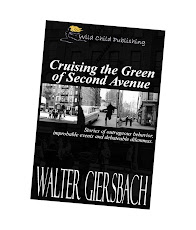
Separately, I’m sad to hear from my editor at Wild Child Publishing, Faith Bicknell-Brown, that she’s leaving the organization. She’s the sort of person who would blue pencil a phrase, mixed metaphor or anachronism in my collection, Cruising the Green of Second Avenue, and demand an explanation. Usually, it was my oh-my-Gawd mistake. Thanks, Faith, for your encouragement and…well, faith in my writing. You’ve been the spoon to stir my coffee. (Is that metaphor okay?)
The story examines an environment that’s a few degrees off center, drifting toward that elusive sense of unreality. But then, isn't that what hedge funds, children’s wishes and waking dreams are all about?
Separately, I’m sad to hear from my editor at Wild Child Publishing, Faith Bicknell-Brown, that she’s leaving the organization. She’s the sort of person who would blue pencil a phrase, mixed metaphor or anachronism in my collection, Cruising the Green of Second Avenue, and demand an explanation. Usually, it was my oh-my-Gawd mistake. Thanks, Faith, for your encouragement and…well, faith in my writing. You’ve been the spoon to stir my coffee. (Is that metaphor okay?)
Wednesday, February 18, 2009
Bad Usage, Bad! (A Rant)
The misuse of two words—fulsome and enormity—are fingernails on the blackboard of my nervous system. James Wolcott, not usually guilty of careless locution, writes in Vanity Fair (February 2009), “My fellow comrades are still walking around with Obama buttons stuck to their fulsome bosoms.” Ouch! Fulsome means offensively flattering or insincere, ME disgusting. Oh, James, how could you!
Then our beloved leader Barack stood at the lectern and pronounced on the enormity of our financial meltdown. Well, the country’s broke, but I’m still $47 to the good. Still, enormity means excessive wickedness or outrageousness. Yes, Bernie Ponzi—er, Madoff—can be accused of enormity, but Barack really meant enormousness.
There, I’m glad I got that enormity off my fulsome chest. But James and Barack, I’ll be watching.
Oh, damn, I couldn’t stop without passing on this gem from the att.net homepage today: “On Net This Week: Spring Fashion for the Economically Conscience. Whether you want to role back the hands of time to some of the most controversial trends of the 80’s or borrow fashion tips from our incredibly stylish first lady, this spring will be a unique blend of fashion.”
How many “gotchas” can you find? Conscience should be conscious, and role should be roll. And then, why doesn’t this entertainment scribbler connect frugal buying with retro fashion or the First Lady’s (caps, please) clothing? My retort to AT&T’s OJT writers: “Thoughts tumble in your heads, making and breaking alliances like underpants in a dryer without Cling Free.”
Then our beloved leader Barack stood at the lectern and pronounced on the enormity of our financial meltdown. Well, the country’s broke, but I’m still $47 to the good. Still, enormity means excessive wickedness or outrageousness. Yes, Bernie Ponzi—er, Madoff—can be accused of enormity, but Barack really meant enormousness.
There, I’m glad I got that enormity off my fulsome chest. But James and Barack, I’ll be watching.
Oh, damn, I couldn’t stop without passing on this gem from the att.net homepage today: “On Net This Week: Spring Fashion for the Economically Conscience. Whether you want to role back the hands of time to some of the most controversial trends of the 80’s or borrow fashion tips from our incredibly stylish first lady, this spring will be a unique blend of fashion.”
How many “gotchas” can you find? Conscience should be conscious, and role should be roll. And then, why doesn’t this entertainment scribbler connect frugal buying with retro fashion or the First Lady’s (caps, please) clothing? My retort to AT&T’s OJT writers: “Thoughts tumble in your heads, making and breaking alliances like underpants in a dryer without Cling Free.”
Monday, January 26, 2009
History Talks to Me. (You? Us?)
Someone—Alexis de Toqueville?—called Americans autodidacts. We teach ourselves and proudly ignore authority. But something in that description made me dig around to find out who that English aristocrat was who rebelled against the Crown in 1675-76 Virginia, burned Jamestown, and attacked Native American camps with abandon. His actions—known as “Bacon’s Rebellion”—capture the tenor of the times. They may also be applicable to our world today as we struggle to regain control of government.
My synthesis is that it’s difficult to look at 17th century American history without generalizing the clash of cultures as “grasping Europeans annihilating the Native American” or “angry savages attacking innocent settlers.” Neither was the case, of course. Theirs was a power struggle between strong egos representing established government, populist immigrants and indigenous peoples.
The article (and photos posted with the footnotes) can be read at http://www.militaryhistoryonline.com/17thcentury/articles/baconsrebellion.aspx.
On another historical note, I was pleased to have my article on “Barrancas: The First Shots Fired in the Civil War” reprinted in the Camp Chase Gazette, a reenactors magazine. The piece—as above, written because of curiosity—was first carried in Military History Online (http://www.militaryhistoryonline.com/civilwar/misc/barrancas.aspx) Originally published in Jan. 2005, “Barrancas” is a review of the initial assault on a Union fort, four months prior to the fall of Fort Sumter. That dramatic confrontation included a four-month stand-off and spies who aided the Union cause. Among all the statues and medals for heroism, I don't think there's any comparable testimonial to the intrepid courage of Lt. Adam Slemmer and 82 Union troops.
My synthesis is that it’s difficult to look at 17th century American history without generalizing the clash of cultures as “grasping Europeans annihilating the Native American” or “angry savages attacking innocent settlers.” Neither was the case, of course. Theirs was a power struggle between strong egos representing established government, populist immigrants and indigenous peoples.
The article (and photos posted with the footnotes) can be read at http://www.militaryhistoryonline.com/17thcentury/articles/baconsrebellion.aspx.
On another historical note, I was pleased to have my article on “Barrancas: The First Shots Fired in the Civil War” reprinted in the Camp Chase Gazette, a reenactors magazine. The piece—as above, written because of curiosity—was first carried in Military History Online (http://www.militaryhistoryonline.com/civilwar/misc/barrancas.aspx) Originally published in Jan. 2005, “Barrancas” is a review of the initial assault on a Union fort, four months prior to the fall of Fort Sumter. That dramatic confrontation included a four-month stand-off and spies who aided the Union cause. Among all the statues and medals for heroism, I don't think there's any comparable testimonial to the intrepid courage of Lt. Adam Slemmer and 82 Union troops.
Monday, January 19, 2009
Who Was that Masterful Writer and Illustrator?
A nice incident came around this past week as the American Book Collectors of Children’s Literature newsletter carried my longish piece on children’s book author/illustrator Holling Clancy Holling. (See www.abcocl.org and click on Vol. 20 No. 2 in the Archives.) HCH has fascinated me since childhood, as much for his magnificent drawings as for the curiosity of a man who named himself twice. Paddle-to-the-Sea, Tree in the Trail, Seabird and the other Houghton-Mifflin titles are luxurious in their drawings and sidebar intelligence.
This was a writer whose books are still in print almost 70 years after winning a Caldecott prize. Curiously, there’s very little in print about HCH, and biographies are limited to the most obvious details. However, a librarian near Holling’s home county came to my rescue with “hometown” information, and a researcher at the Leslie (MI) Area Historical Museum offered a bounty of undiscovered details. After more than a year of doing detective work into his life, I’m sure there’s a great deal I still don’t know about him. But it’s this serendipity in tracking down clues and details that made this a rewarding project.
This was a writer whose books are still in print almost 70 years after winning a Caldecott prize. Curiously, there’s very little in print about HCH, and biographies are limited to the most obvious details. However, a librarian near Holling’s home county came to my rescue with “hometown” information, and a researcher at the Leslie (MI) Area Historical Museum offered a bounty of undiscovered details. After more than a year of doing detective work into his life, I’m sure there’s a great deal I still don’t know about him. But it’s this serendipity in tracking down clues and details that made this a rewarding project.
Thursday, January 1, 2009
Happiest of New Years
Here’s wishing everyone a healthy, bountiful New Year. May your favorite bookstore remain a welcoming hearth through these perilous times, may all your rejections from editors and agents be positive and constructive, and any gift cards you received continue to be negotiable. To Barack Obama, here’s hoping his new home at 1600 Pennsylvania is fulfilling, and that a dictionary there shows him the word is not pronounced “ir-re-VOC-able. To departing Dick Cheney, an invitation to take up water boarding, assuming there’s no surfboarding in Wyoming. And, let us all have a moment of silence for the demise of Polaroid film before cheering the advent of phonographs that convert our 33 and 45 rpm records to digital files and CDs.
Saturday, December 20, 2008
Hello? Is Anyone There?
The Tribune Corporation is declaring bankruptcy. A Glendale, Calif., paper is outsourcing its news-gathering to India. My granddaughter writes her book review on her iPhone while watching TV. Is this the end of written communication as we once knew it?
The writers I knew—literate, insightful, thought-provoking—are being replaced by bloggers... Readers are downloading e-books instead of buying paper... Borders had only one of the 10 New York Times recommended children’s books I was searching for when I shopped last week... My former employer was the largest independent yellow pages publisher in the U.S., but its stock has dropped from $62 to 33 cents as people shuck the damn books out in the garbage... And Sarah Palin has a $7 million book deal coming to tell us all how to “progress freedom in the U.S.”
Then I ran across a jaw-dropping cultural benchmark in a New Yorker ad. Victory for writers has been snatched from the jaws of defeat by Books by the Foot (http://booksbythefoot.com/). The firm offers modern cloth-bound hardcovers for only $6.99 per linear foot. “Tonier” modern cloth with black spines, however, will run $13.99 per foot. The purveyors of this literary wealth—by the foot, not the words—remind us that Heinrich Heine stated, “A house without books is like a room without windows.” The motto of this “bookyard” then—this Home Depot of illiteracy—must be a God-like “Let us have light!”
How many layouts in Architectural Digest show rooms without books—truly a mark of the plebian mind of a hedge fund manager. The badge of real literacy is to display yards of books when your guests come to swill champagne. Then, when the casual visitor asks if you've read them, you can say, “My interior decorator may have, but I don’t need to. I pay his/her salary.” This is perhaps the same decorator who goes to Barnes & Noble looking for a red book...to match her purse.
On the upside, I found a superb historical analysis of 17th century Virginia, written in 1917, free at Google books! Now I can publish my article on Bacon’s Rebellion. Circle the wagon, Folks. It’ll be hard times when the printed word disappears.
The writers I knew—literate, insightful, thought-provoking—are being replaced by bloggers... Readers are downloading e-books instead of buying paper... Borders had only one of the 10 New York Times recommended children’s books I was searching for when I shopped last week... My former employer was the largest independent yellow pages publisher in the U.S., but its stock has dropped from $62 to 33 cents as people shuck the damn books out in the garbage... And Sarah Palin has a $7 million book deal coming to tell us all how to “progress freedom in the U.S.”
Then I ran across a jaw-dropping cultural benchmark in a New Yorker ad. Victory for writers has been snatched from the jaws of defeat by Books by the Foot (http://booksbythefoot.com/). The firm offers modern cloth-bound hardcovers for only $6.99 per linear foot. “Tonier” modern cloth with black spines, however, will run $13.99 per foot. The purveyors of this literary wealth—by the foot, not the words—remind us that Heinrich Heine stated, “A house without books is like a room without windows.” The motto of this “bookyard” then—this Home Depot of illiteracy—must be a God-like “Let us have light!”
How many layouts in Architectural Digest show rooms without books—truly a mark of the plebian mind of a hedge fund manager. The badge of real literacy is to display yards of books when your guests come to swill champagne. Then, when the casual visitor asks if you've read them, you can say, “My interior decorator may have, but I don’t need to. I pay his/her salary.” This is perhaps the same decorator who goes to Barnes & Noble looking for a red book...to match her purse.
On the upside, I found a superb historical analysis of 17th century Virginia, written in 1917, free at Google books! Now I can publish my article on Bacon’s Rebellion. Circle the wagon, Folks. It’ll be hard times when the printed word disappears.
Subscribe to:
Posts (Atom)