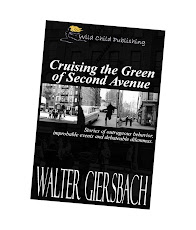
Cruising the Green of Second Avenue

Wild Child Publishing has issued the second volume of short stories in Cruising the Green of Second Avenue. The tales take up where Vol. I left off — bringing back Klein the Biker, Straight Charlie and Sammy the Madman while introducing new characters stumbling over life’s difficulties in the late 60s. Vol. II is an e-book published by Wild Child Publishing that you can download, save as a pdf (Adobe) file and print. Read both volumes and see that life isn't all that serious. Find it at Barnes & Noble, Amazon and other online book sellers.


Monday, December 10, 2012

Gobbling Up the Whole World

Someone facetiously said that when an inveterate collector installs smoke alarms, the first one goes in the place he stores his collection.  I understand because I’m a collector without — I hope — being anally compulsive.
A few glasses from my collection of 300-plus.

I started with matchbooks in the ‘50s, especially those with Petty girl pinups.  And coins, stamps, arrowheads, junior pilot wings from airlines, and sugar packets with restaurant names as our family criss-crossed the U.S.  Now, more than ever, I relish those ephemera that have disappeared.  There were clever plastic styluses a woman used to dial a telephone without breaking a nail.  Pocket mirrors with advertising on their celluloid backs.  Toogles — the metal hooks with a faux jewel on the end women used to hang their pocketbooks on a table edge.  Other things are gone or going fast, like metal lunch boxes and fast food collectible glasses.

Collecting and the search was the basis for a short story I wrote about flea marketing (and love, with a happy ending) published in R.kv.r.y. magazine (at http://www.rkvryquarterly.com/?p=81).  My character of Archie Mezinis was “a boardwalk stroller, a country road rambler, a city street seeker.  His compulsion lay in taking an hour to walk up and down the lanes between the [flea market] tables.  His practiced eye could spot a three-inch Meissen figurine and know it was really Japanese, or a Murano cigarette time worth twice the asking price now that smoking was socially hazardous.  He didn’t sell the finds.  Instead, they went into a footlocker.  A single item in his pocket could validate his whole existence for the next week, reinforcing an existential question as to whether he was truly alive.”  Now, that’s collecting!

The value of collecting — and nature of love — were notably present in Cadillac Jack, Larry McMurtry’s haunting story.  Jack is a rodeo cowboy turned antiques scout who floats across the landscape of flea markets and auctions.  Unlike me and most collectors I know, McMurtry’s Jack was a womanizer and skirt chaser.   

Name a friend who doesn’t collect something.  At worst, it’s wanting to own one of everything in the world.  At best, it’s a desire to hold on to history.  Somewhere in between, it’s simply nostalgia.  I just don’t know where having over 300 glasses in my attic stands on the spectrum of collecting.  But you’re either part of this world — or not.  Ain’t no in-between.
 

Monday, October 1, 2012

Tempis Fugit, Write Concisely

Time slips through our fingers like (clichĂ© warning!) sand.  Never enough of it to do all we want, especially never enough time to read. 
 
Just a reminder that Banned Books Week is Sept. 30-Oct. 6.


This is why flash fiction — generally accepted as stories of fewer than 1,000 words — is gaining in popularity.  It’s also accepted that flash is tougher to write successfully than a traditional short story.  Characters must be presented succinctly and in as few words as possible.  There is no space for meandering off into descriptions that don’t push the story line ahead.  Time is usually constricted to the immediate here and now and space is circumscribed. 

I gravitated to flash because the length and style can be applied to any genre — mystery, romance, thriller, “literary,” humor/satire, Western.  Unknowingly, I tripped innocently into writing and selling my first flash in 2007 with the sale of “Not My Wife” to the now-defunct mystery magazine Mouth Full of Bullets.  It started with my Hong Kong cop Jimmy Huang talking about a murder suspect….

Right now, I’m looking at this hwa-chiao, a Chinese-American tourist at the station house who’s bitching at Inspector Chan.  He claims he’s an important visitor.  He’s shaking his finger and saying, “I report my wife has disappeared, then I came back to find an imposter in my hotel room, not even a good duplicate.”  Of course, from his mouth it comes out like “fucking imposter” and “goddamn duplicate.”  Most perps use bad language to show their sincerity.  This guy is the slickest I’ve seen and I’ve seen a lot of them, from Guangzhou to Macao.  His missing wife was Shanghainese and one of the richest broads around.  Now he claims this woman at the hotel really isn’t his wife.

The inspiration for the story was discovering a fascinating condition known as Capgras syndrome, after the French shrink who discovered it.  It’s when you think a close relative or spouse has been replaced by an imposter, an exact double.  (Send me an e-mail if you’d like to know how Detective Huang solved the murder in 744 words.)

Since that time five years ago, I’ve written and published, in print and online, some 36 flash fiction pieces.  Half a dozen of them have appeared in one of the great online publications, Every Day Fiction.  You can read “Death in the Afternoon,” one of my early sales, at http://www.everydayfiction.com/death-in-the-afternoon-by-walter-giersbach/. 

Best part of writing for immediate gratification is that I trip over loads of prompts.  “Number Eleven” concentrated on the terrible coincidence of the number of letters in a phrase or name; “Fifty Ways to Leave Your Lover” by Paul Simon made me think of a 51st event that might have won the Darwin award for stupidity; “Queen at the End of the Bar” (http://www.gumshoereview.com/php/Review-id.php?id=2915) was inspired by pollution causing biological changes in wildlife (and humans?); and “Where’s Old Bill Hughes” was prompted by a mythical passenger who has survived shipwrecks for 200 years. 

Now, someone help me with a story surrounding prosopagnosia, the neurological condition in which person doesn’t recognize faces.  I have a touch of that bad wiring in my brain, and can’t come up with a plot.


Wednesday, August 29, 2012

Ooopsie, I’m Stealing an Idea I Gave to my G-Daughter.


Liberal arts majors are a diminishing species of college student.  In fact, I’m proud of the pre-med track my granddaughter is taking at Temple University.  Specially proud that she’s a good writer.

But in five minutes today, a slew of ideas crossed my mind.  I whipped them up as a series of prompts for Megan to develop for her erstwhile blog.  I know she’ll put her own spin on them, but meantime I’ll try them out on you….

Some Sharp Scribbled Sticks for Pointers

Anne Murphy Paul, a science writer, said, “Character is created by encountering and overcoming failure.”  In reviewing How Children Succeed, by Paul Tough in the New York Times 8/26, she explains that American children miss essential life experiences.  They’re insulated by doting parents who “baby proof” them and shield them from adversity.  Poor children, however, get little support to help them turn obstacles into character-enhancing triumphs.

Q.  Are young adults today floating on a cloud that carries them over obstacles, preventing them from learning from life’s difficulties?  How do you view adversity?  As something to be avoided at all costs or as a learning experience? 
* * *
Many schools have given up teaching cursive writing.  Indeed, with all the texting and typing we do, cursive may be a relic of the past.  Some research at Indiana University has shown, however, that learning and using cursive leads to more adult-like brain development in children who write by hand.  There’s more information on a blog at http://campaignforcursive.blogspot.com.

Q.  Would you prefer that your kids learn cursive (even if they hate it).  And, do you think there’s still a place for people to use cursive?

* * *
Every generation looks back on youth and wonder, “Where is civilization heading?”  (Socrates, I’ve heard, also voiced this question.)  Young people seem predisposed to shake up their world — challenging authority, their teachers, government, culture.  Sure, there was the “quiet generation” in the 1950s, and people seem more restrained during hard economic times.  But the 1960s and ‘70s were a time of great demonstrations against the status quo.

Q.  Are young people predisposed to turn everything upside down, or should they just shut up and go along with the mainstream?

* * *
Most people seem to believe national prosperity leads to happiness, but one poll suggests a minority (47%) don’t believe money equates to “happiness.”  In fact, Federal Reserve Chairman Ben Bernanke recently noted, “the ultimate objective of our policy decisions” is to promote well-being — a broader consideration than simply having more money.  The Himalayan country of Bhutan has even given up its “gross domestic product” measurement for a “gross national happiness” measurement.

Q.  Should the U.S. concentrate on physical, mental and spiritual health; time balance; social and community vitality; cultural strength; educational levels; living standards; good governance; and ecological vitality and drop all this effort to make more money?  How would we measure “happiness”?

Thursday, July 26, 2012

Searching for the Real McCoy


       Forest Grove in the 1950s

My passion for authenticity began in Forest Grove, Oregon.  Mom ordered me to run down to Cooper’s Grocery to buy the maple syrup she’d forgotten.  I had to put down my new Amazing Tales comic and turn off Bobby Benson’s Saturday morning program from the B-Bar-B Ranch. 

“And hurry!” she said.  “I’m ready to put the pancake batter in the griddle.” 
 
I trudged the long block down to 21st Street, another block past the Congregational Church, and a half block down Main Street to Cooper’s.  All blocks are long when your eight-year-old legs aren’t very big. 

Mr. Cooper was a daunting figure behind his brushy mustache and white apron.  Silently, he’d leave the counter and fetch the item you wanted.  I returned home with a bottle of Aunt Jemima syrup, thinking it was pretty clever to make a bottle in the shape of a woman wearing floor-length dress.  This was beauty combined with utilitarian value. 

Mom stared at me.  “Why, this isn’t Log Cabin!”   

“It’s the same thing,” I said defensively.  “Anyway, I like the bottle.” 

“It’s not one hundred percent maple syrup!” she explained, as though I had introduced heresy to our church service.  “It’s not the real McCoy.  Go back and tell Mr. Cooper you want the real thing.”

I plodded back.  Red-faced with embarrassment, I said, “Mom wants Log Cabin maple syrup.  The real McCoy.”  He nodded wordlessly and went down one of the dark aisles to fetch the syrup in the metal can shaped like a log cabin.  They were good cans, worth saving to build a town of homogeneous houses, a tabletop version of a pioneer town, but I already had several.  

The real thing was important.  Dad told cautionary tales of people in Germany so desperate they put chicory — whatever that was — and other foreign matter in their coffee.  He said, “During the war, the Germans were so poor they would eat grass.” 

Authenticity was paramount.  Usually.  Butter was always butter, for example, until Mom brought home a strange invention.  “It’s margarine,” she explained. 

“But it’s white,” I whined.

“It’s Parkay, and it’s white so people don’t think it’s real butter.  It’s the law that you can’t fool people into thinking something is the real McCoy.”

The plastic bag resembled cheese curd from the creamery in our town, but with the addition of a little orange dot of dye.  Invariably, I was ordered to massage the bag for half an hour until it all turned yellow.  We knew it wasn’t real, but it was novel and cheaper, and so a trade-off was made.

Choosing between the real and the novel was a dilemma as the 1950s appeared.  A Safeway supermarket opened two doors away from Cooper’s, and an entirely new item appeared: TV dinner:  A TV dinner meant, by definition, eating in front of a television. 

“We don’t have a TV,” Mom explained.  “They’re much too expensive, and there’s only one station.”

“C’mon, Ma, buy some TV dinners,” I urged, although the only TV we knew about flickered in the window at Montgomery Ward’s.  Several times she relented.  Somehow, the thin slices of turkey didn’t taste like Mom’s cooking, and the mashed potatoes had so few lumps we wondered what they were made of. 

The whole reality question came crashing back when my kids were growing up.  My wife cooks scratch, and we’ve always had the smallest bag of tins and bottles to recycle.  Meat, stir-fried vegetables, rice, salad — preparation takes a while, but the cooking goes together in a few minutes.  Then I’d watch my kids' friends at the table.

“What’s that?” one would ask my son, and nudge him in the ribs.

“Beans.”  Or spinach or broccoli or cabbage, usually with pieces of chicken, beef, or bacon.

“It doesn’t look like it.”  Then, they’d settle for white bread and margarine.  Reality had to come in brightly colored packages.

About that time, I was shocked to see Log Cabin had reduced the maple syrup content to 8 percent.  Coffee with chicory from New Orleans is now a delicacy.  Instant food became the norm for people who have a parking meter in their brain measuring time.

It’s tough finding the real McCoy in a world that’s accelerating. 

Sunday, July 8, 2012

Waiting for God to Be Your Tour Guide

The Rose and Thorn Journal was kind enough recently to publish “Test of English as a Foreign Language” (at http://www.roseandthornjournal.com/Spring_2012_Prose_1.html).  It was a piece I felt strongly about, and it took the better part of five years to bring it to a publishable state.

Rose and Thorn has also asked — kindly, of course — what on earth I was thinking of.  The germ of the story has gnawed at me for many years — since 1979 when I returned to Taiwan on a business trip.  I met up then with my wife’s girlfriend who had married an American, lived several years in the States, and came back when her husband was reassigned to Taiwan.  It was awkward when I saw her treated in Taipei’s marketplace as an American hwa-chiao (foreigner on a homeland visit), but as a bargirl when she tried calling her husband stationed at a military post.  

She was no longer Taiwanese and not yet American.  Of the many stories I know about bi-national people, this one stood out.  And deserved to be shared.

I also wondered if perhaps we’re all expatriates of one sort of another as we swim through any murky pool filled with strangers.  I’ve always had a creepy feeling about being a tourist — buying a vacation, looking confused in a new city, acting gawky and “foreign.”  Perhaps it’s because I used to scorn the clots of vacationers clustered in midtown Manhattan, holding maps and looking at the skyscrapers as though God would be their Gray Lines tour guide.  While I was in a suit and tie rushing across town on some mission of capital importance, I’d have to stumble and detour around these Ausländers in their blousy sports shirts and khaki shorts. 
           
So add to the expatriate syndrome in “Test of English” the despair of a dead child and a divorced husband and you have the making of universal tension.  Key to writing the story was the characters’ realizing how hard it is to be accepted.  Rightly or wrongly, Shirley felt Americans were “predisposed to believe that American men only married bargirls.”  Orville, too, had difficulty with his environment, saying, “It was all getting to me.  The telephones and car horns.  Fire sirens, even chatter at parties.  It was all like a toothache. It was getting on my nerves.”

How can feeling like a stranger be otherwise when store clerks answer an expat’s question by turning to her spouse, when locals are perplexed by an unfamiliar accent, or when an in-law ingratiatingly says all children or women in [insert country name] are beautiful or intrinsically smart or better at sports?  These are the preconceptions — if not prejudices — that all Asians are good at math (and, by extension, at gambling), that immigrants must all have come from a certain class or occupation, and that some people have in-born diet preferences.

Let me make a case that there’s a universal feeling of discomfort among expatriates, beginning with Moses coming back to Egypt announcing, “I have been a stranger in a strange land.”  I’ll grant you, it’s easier to be an expatriate in the U.S. than in, say, an insular nation like Japan.  America is a nation of immigrants.  A Hungarian engineer once told me, “I worked in Germany for several years, but to them I was always a Hungarian.  In the U.S., I’m called a ‘new American.’”

“Test of English as a Foreign Language” tries to approach this situation of apartness.  Writers feel compelled to connect with people, to cross cultural bridges, and to obliterate barriers.  Perhaps through writing and reading — passing our test of English as a foreign language — we can all become assimilated.  For aren’t we all “new Americans” in one way or another?

Thursday, June 28, 2012

Score: Lincoln Loses, So Does O’Reilly

Lincoln’s assassination in 1865 was as shocking as President Kennedy’s almost a century later, but reflected a country still polarized by war.  Killing Lincoln by Bill O’Reilly and Martin Dugard unrolls the drama leading up to John Wilkes Booth’s infamous act while unveiling the band of amateur conspirators.  In fact, history classes tend to skip over the widespread rabid hatred of Lincoln and the motley group that conspired to murder the President.  Perhaps it’s good to be reminded of such things.  O’Reilly earlier wrote Killing Kennedy, so let’s hope there are no more presidential assassinations.

But how true is the fictionalized treatment?  A seven-page index offers no sources, nor does the prologue, but O’Reilly fills his work with interior thoughts and imaginary conversations the way an Ă©clair is puffed up with cream filling: light and airy, but not nutritionally good.  The Huffington Post also uncovers additional factual errors. This is history for non-history buffs, delivering a quick back story of the Civil War generals and their final battles, the political animosities blocking the generosity of our “greatest President,” the nationwide chase to find the assassin, and the tragic aftermath of hanging a possibly innocent Southern woman sympathizer.  It’s a fast read and will deliver information you never learned in school.

This is not a bad book, but somewhat thin after wading through Drew Gilpin Faust and Bruce Catton.  By the middle of June, the book has spent 36 weeks on The New York Times list and is in fourth place among non-fiction works.  This may say more about American reading tastes and Bill O'Reilly's popularity among a certain demographic than it being an original contribution to history.

Historical novels are an enchanting genre that leads readers into the dark corridors of the past.  We walk unseen next to characters — some we’ve heard of and some fictional — who are explorers and adventurers, romantic lovers and nefarious brigands.  Politicians are exposed, the self-righteous are quashed, and the meek inherit the earth before everyone goes home for the day.

Killing Lincoln is a  non-fiction adventure set against a historical backdrop.  Can we dare imagine the guaunt Presidet (with "furled brow") walking alone through cheering throngs at war's end, heedless to the warnings he mght be assassinated?  Do we gasp seeing General Grant show up at the peace table in Appomattox with muddy boots to remind the impeccably dressed General Lee how he was upbraided for sloppiness during the Mexican War?  Do we titter to overhear the conversation between Lincoln and his wife in the closed carriage on the way to Ford's Theatre?  

Killing Lincoln is populist literary drama for our times, in which the past and present coexist contemporaneous with each other.  It's branded "history" that really isn't history.  The drawing room drama of Mary Todd Lincoln's ressentment and state-room drama of Lincoln casually dropping in on Secretary of War Stanton could be played out today in a soap opera or on a calbe channel.

Artist and writer Douglas Coupland calls this new literary genre Translit:  “Translit novels cross history without being historical; they span geography without changing psychic place.”  The contemporary reader is tossed into the past without having to leave the present.  It’s almost as if, Coupland says, one “can travel back to Victorian England — only with vaccinations, a wad of cash and a clean set of ruling-class garb.”

In this case, we’re given gripping moment-by-moment drama.  O’Reilly and his partner Dugard adopt the narrative tricks of short writing sections and quick cutting worthy of “breaking news” on Fox News, where O'reilly stated, "I wasn't interested in another boring history."

Thursday, June 21, 2012

Shred Your Library (after You’re Dead)

That’s called an attention-getting headline, taking us into a narrative hook.  Truth is, no one wants your bookcases just because they’re full of your memories.  Your kids and other survivors will sweat, wondering what the hell to do with books when you’re gone. 

You can truck them down to your library and they’ll give you a note with a fill-in-the-blank for the appraised value.  The books will go on their shelves for sale at 50 cents each.  I’ve gleaned the unwanted books from my “library” and put them in the bathroom, inviting guests to take one, or two or three at no cost.  Thing is, people go into the can and don't come out, with or without a book. 

Books don’t get the respect they used to.  One of my kids had a carton filled with a score of copies of a detective story.  The same book.  Twenty copies of Silent Partner by Jonathan Kellerman.  Why?  “I use them for target practice,” he said. 

For years, I had the toughest time not finishing a book — even a free book.  I had a moral obligation to read the entire goddamn book.  (Traumatic memories of Mom telling me to clean my plate.)  Then I learned certain books are meant for skimming, others to read and re-read, and a sizable number tossed aside because they’re badly written (Thomas Matthews’ Rejection: a Lou Drake Mystery), or boring (Cockpit by Jerzy Kosinski), silly (anything more by Jasper Fforde) or offensive (The Island, Peter Benchley). 

In my hormone-filled high school years, I read Sagan’s Bonjour Tristesse three times in English and once in French, mooning over the exchange student on the school bus.  Vonnegut’s Slaughterhouse Five is another I became enthralled with in 1969 and again in ’06. 

I’m religious about taking care of a well-printed and bound book.  (I always use bookmarks.)  The potboilers I buy for four bits each at the library are also treated with respect.  Some, like Allen Ginsberg’s first edition City Lights copy of Howl, is carefully preserved.

I’ve assiduously kept a list of every paper or electronic book I’ve read since 1973.  The inventory tells me to stop reading facile feuilleton (as Herman Hesse called them) and begin reading more fiction by Jonathan Lethem and Paul Auster, or non-fiction by Nathaniel Philbrick and Bruce Catton.  The list memorably reminds me that a hooker in Korea passed along my copy of Ken Kesey’s One Flew Over the Cuckoo’s Nest, obviously left behind by a previous visitor.  There were periods when I snatched up everything by Junichiro Tanizaki, Richard Condon and Philip K. Dick.  I still buy everything by Elmore Leonard, Martin Cruz Smith, Caleb Carr and Pete Hamill. 

Now, the titles tumble in my brain like socks in the clothes dryer.  Why did I buy a second copy of Elmore Leonard Killshot?  Forgetfulness.  And, which of William Gibson’s foresightful novels haven’t I read?  I grit my teeth and know that I either need to carry a 26-page printout or find some cranky electronic device like an iPhone to store the document.  But, wait!  I think I can save the list as a PDF file and transfer it to my wheezy old Palm Pilot. 

Sorry, now, but I gotta run. Just had an idea.