It seems like the summer of spinning my wheels, but I look back and think I accomplished something.
Last week, “Where’s Old Bill Hughes, Now?” was published at The World of Myth as an action/mystery story. (See http://www.theworldofmyth.com/.) It’s a quirky little thing that bugged me for years because there really, really was a William Hughes who “kept popping up.”
And, did I forget to mention that “Misunderstood Identity” was published by Big Pulp in soft cover in July 2011, and online at http://bigpulp.com/issues/2011_09/giersbach_misunderstoodid.html. Life is a mystery, but that doesn’t mean a guy has to put up with someone stealing his identity.
Two others pieces are also slated for publication. I ranted earlier about women writing from a male point of view (and vice versa). “Gender Bias in Writing” will be published by Flash Fiction Chronicles on/about Aug. 27. Now, the mystery remains: Is gender-specific writing biological or cultural or …?
Finally, “Big Biz @ the Mall” will be pubbed by The Corner Club Press shortly. But let me stop and come back to Big Biz in a matter of days. We’ll talk then about language and netspeak and leet.
I think a couple of mysteries have been solved regarding my fave children’s book writer, Holling Clancy Holling. Go to http://hollingcholling.blogspot.com for the story of how another piece of this man’s commercial artwork was finally catalogued and archived. And the second mystery had to do with connecting a correspondent with the Leslie, Mich., museum director to help identify one of Holling’s early illustrations. More on that to come, as the mystery hasn’t been completely solved. Yet.
Tuesday, August 16, 2011


Friday, July 29, 2011
The Power of the Pen—er, Networking
A month ago I was in a state of despair. Oh, excuse me for being weak-minded, but when I buy the Sunday Asbury Park Press at my 7-Eleven, the first thing I read (really, and before the comics) is Anne Bendheim’s column on “What You’re Reading.” This is a review each week on what a reader submits that he/she finds interesting. I’ve had seven reviews published there.
I don’t know how many of you read Sunday’s Asbury Park Press, but you may have noticed on June 26 that the “Tell Us What You’re Reading” column was missing. I fired off a shocked e-mail to Anne, who edits the page. (Anne describes herself as not being on Facebook and “the only person in New Jersey without a cell phone.”) I wrote, “This page is the only voice of the people, except for reader rants on the Op-Ed page.”
She replied, “I had no choice but to pull the column. I had no reader responses for more than six weeks. I was reduced to calling my friends for their suggestions—and I ran out of friends.” Isn’t that an outrageous state of affairs?!
Now, Anne was suggesting that “it might be the case” for the column to be reinstated if she were deluged with thumbnail book reviews. She’d need four or five in advance.
It’s a simple process to send an e-mail to abendheim@pressmedia.com about the book you are reading, and a short description of the book and why you like it. Include your name and town, and put “What I’m Reading” in the subject line.
I wrote a note to the two score names on our Writers’ Circle mailing list, suggesting they stop and send a review now. I told them, “C’mon. We’ve read Peter Pan, and we know Tinker Bell will live if we all clap our hands — and post a book review.” That done, I sent a note to the Monmouth County writers’ group on Yahoo! I sent individual e-mails to others I knew were literate. And then I sat down to scribble a review of Caleb Carr’s The Italian Secretary.
The next day, Anne sent me a note, saying she “just got a new cat and named her Tinker Bell.” Is that a coincidence or what? A week went by with no review … and then it appeared. The following week, my Caleb Carr review appeared. I won’t take credit for this, but in a small way I hope I’m responsible for bringing back interactive reader-newspaper communications on the subject of books we like.
Wednesday, July 20, 2011
Tubing Down the Stream Called Summer
I admit it. I have little discipline to keep up this blog unless news intrudes. There’re distractions like drinking beer on the boardwalk. Moderating a writing group. (I’m so proud of them — us.) Going to jazz and wine festivals. Hanging out with my family. The usual summertime activities.
But to the news. Bewildering Stories has just published “Fish Stories and the Mermaid,” at http://www.bewilderingstories.com/issue439/fish_stories.html. I was chided that this was PG-rated and I should have issued a warning to young people (who already know things I have to look up, like what a “Norwegian ice rocket” is).
But don’t distract me. What I want to say is that I ran across a heavy word: synanthropes. (It’s G-rated, so keep reading.) The word refers to curious ways that animals adapt to humans as they’re crowded out of their habitats. For example, trainers in Hawaii’s Sea Life Park were stunned when a 400-pound gray female bottlenose dolphin gave birth to a dark-skinned calf that resembled the 2,000-pound male false killer whale with which she shared a pool. The calf was a wholphin, a hybrid that was intermediate to its parents in some characteristics, like having 66 teeth compared with the bottlenose’s 44 and the 88 of the false killer whale, a much larger member of the dolphin family.
Talk about moral breakdown! This sent me to the keyboard. There was a story here! But in July ’09 the first editor rejected “Mermaid,” saying “I was expecting something more ‘mythic,’ something more in keeping with the theme of ‘synanthropes.’” The next editor said, “Ummm, this is an entertaining story, but I have to say no to it. Largely, I'm not into stories where the punch line is basically, ‘I'm pregnant.’” The third editor flatly stated, “Unfortunately, we cannot accept your story for publication.” Cannot? Like, I made a mistake and sent this to a children’s mag? The fourth editor remarked, “Although we really liked the voice of this piece, we both felt that it was the beginning of a story that could go much further.” No, sorry. That was the story. The fifth editor had two objections, apparently pulled from a list: “Incorrect formatting, language, italicized words not underlined” and “The genre of this story was not clearly defined. It read more like a ‘slice-of-life’ story than anything that I would consider fantasy, horror or science fiction.”
Finally, a sixth editor wrote back, “Thank you for ‘Fish Stories and the Mermaid.’ It's one of your most interesting ones.” Don Webb, editor of Bewildering Stories, then proceeded to point out — accurately and line by line — where I had been careless. He asked if I could help readers over these rough patches. I said I could indeed. That was in mid-spring of this year.
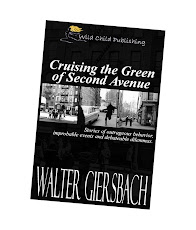
Thank you, Don, for running six of my stories and an excerpt from my Cruising collection over the years. Bewildering Stories is one of the best.
Friday, July 1, 2011
The Enchantment of Flea Markets

I’ll be the first to admit that collectors often are avaricious people who want to swallow the whole world. Often, however, they restrain themselves to collecting all of a single class of objects. My weakness is cast iron ashtrays with figures, usually drunks leaning against lamp posts. I have a dozen of ‘em. And white-knob windup toys, of which there are scores sitting in the attic.
This led me to write “Million Dollar Find,” a story published June 30, 2011 in r.kv.r.y., an online magazine, at . R.kv.r.y., explains editor Mary Akers, is the phonetic spelling for recovery; these are stories of the recovery process. Was my protagonist Archie Mezinis recovering or just searching? He’s a widower and retired who wanders. His week’s happiness is assured if he finds one of those plastic pencils with a ball at the end — a telephone dialer from the 1950s shaped to keep women from breaking their fingernails. Or a toogle. (What? You don’t know what a toogle is?)
The story was meaningful for me to write because of associations and — well, some things are disappearing and need to be saved. (The first draft was done in 2007.)
As many of you know, the flea market is a field of dreams for the Saturday-morning searcher — a place where past and future meets and the unraveled pieces of lives are knit together. Often, the treasure found is unexpected. I used to drive my daughter to Englishtown on summer Saturdays where she sold T-shirts and sweats. And I’d walk the avenues quickly, scanning every table in half an hour. It’s where I began picking up fast food collectible glasses, which at one point reached over a thousand in quantity.
To this publication, there’s other good news to add:

“Nature Story” was published in Summer 2011 in the Southern Fried Weirdo: Reconstruction anthology (p. 251-53) to benefit tornado victims. Ornithology wasn’t Jerome’s strong suit, but then Jerome wasn’t a normal child. You can download this book from Smashwords, find some enjoyable stories and consider the royalties Publisher/Editor T.J. McIntyre is contributing to Alabama tornado victims.
“Carl’s Heightened Sense of Loss” was published by The Corner Club Press in its second issue, pp. 147-149, May 15, 2011, at http://www.thecornerclubpress.com/uploads/6/0/5/3/6053731/the_corner_club_press_issue_2.pdf. An absurd story? Certainly. Offensive? Perhaps, but nonetheless an experiment in a new genre.
Tuesday, June 28, 2011
Cooking Corn Fritter Muffins

Let me get away from the writing thing, and talk food. My very inventive wife has just created corn fritter muffins. You know the deep fried things you eat with syrup? These have chives added, no sugar, and are yum-yum good with butter ‘n’ honey. Betty Crocker Cookoff, here we come.
1 ear of corn (cooked)
¾ C. flour
2 eggs
½ tsp. salt
2 tsp. baking powder
¼ C. milk
3 tbsp. chives, chopped finely
1 tsp. olive oil
Mix all ingredients. Heat oven to 400 degrees. Bake in tiny muffin pans for 18 minutes. So easy a kid can do it!
Tuesday, June 21, 2011
Another Day, Another Rant
Forgive me if I repeat myself, but the world as I knew it is changing.
The Tribune is declaring bankruptcy. A Glendale, Calif., paper is outsourcing its news-gathering to India. My granddaughter writes her book review on her iPhone while watching TV. Is this the end of written communication as we once knew it?
The writers I knew—-literate, insightful, thought-provoking-—are being replaced by bloggers... Readers are downloading e-books instead of buying paper... Borders (pre-bankruptcy) had only one of the 10 NY Times recommended children’s books I was searching for when I shopped... My former employer was the largest independent yellow pages publisher in the U.S., but its stock has dropped from $62 to 33 cents as people shuck the books out in the garbage... And Sarah Palin had a $7 million book deal to tell us all how to “progress freedom in the U.S.”
Then I ran across a jaw-dropping cultural benchmark in a New Yorker ad. Victory for writers has been snatched from the jaws of defeat by Books by the Foot (http://booksbythefoot.com/). The firm offers modern cloth-bound hardcovers for only $6.99 per linear foot. “Tonier” modern cloth with black spines, however, will run $13.99 per foot. The purveyors of this literary wealth-—by the foot, not the words—-remind us that Heinrich Heine stated, “A house without books is like a room without windows.” The motto of this “bookyard” then—this Home Depot of illiteracy—must be a God-like “Let us have light!”
How many layouts in Architectural Digest show rooms without books-—truly the mark of a plebian hedge fund manager. The badge of real literacy is to display yards upon yards of books when your guests come to swill champagne. Then, when the casual visitor asks if you've read them, you can say, “My interior decorator may have, but I don’t need to. I pay his/her salary.” This is perhaps the same decorator who goes to Barnes & Noble looking for a red book...to match her purse.
On the upside, I found a superb historical analysis of 17th century Virginia, written in 1917, free at Google books! Now I can publish my article on Bacon’s Rebellion. Circle the wagon, Folks. It’ll be hard times when the printed word disappears.
Monday, May 30, 2011
Publishing Is Dead - IV
The Oops Factor, or, You Mean I Have to Proofread?
The information technology industry has long been aware of the GIGO factor of input/output: “Garbage In, Garbage Out.” It’s unfortunate that writers usually aren’t their own best editors. POD sadly allows them to escape a strong editorial hand. The result is manuscripts full of factual errors, ungrammatical parsing, spelling errors, and clichéd phrasing.
This is the Devil’s Pact. The writer trades off the benefits of distribution and royalties accruing from POD but forgoes professional guidance. Self-publishing is very much like an indicted person serving as his own lawyer: he has a fool for a client and a fool for a lawyer.
Pundits compare Congressional legislation to sausages: you don’t really want to know what goes into the result. “Vanity press” publishing is also like a sausage full of strange ingredients. A friend, unfortunately, has had her POD book shelved at the area library, and the patrons have taken to marking up the copy for its egregious errors.
At least, Xlibris and Lulu offer some editorial guidance to the neophyte. For a price.
Where Is Publishing Headed?
There was a 6-column-inch blurb in The New York Times noting that Seattle-based Amazon on Christmas Day 2009 sold more e-books for its Kindle reader than it did paper-based books. (In July 2010, Amazon sold 143 digital books for its Kindle for every 100 hard cover books.)
Interesting factoids, but more startling was the next sentence that Laredo, Texas (pop. 250,000) closed its last bookstore. (Laredo's population is only slightly smaller than that of Newark, NJ, one of the poorer urban areas.) I checked my online Yellow Pages, though, and actually came up with eight Laredo bookstores, three of which were Christian and one Spanish-language. Two recognizable names were Barnes & Noble and B. Dalton. That left two that appeared to be independent bookstores.
What's the takeaway? Actually, I came up with five.
One, a lot of people got Kindles for Christmas. (My Seattle-based friend has 4,600 books on his e-reader, most which he admits he'll never read.)
Two, Texans read less than Newarkers, where there are 84 listings for bookstores. Newark's median household income is $26,913. Laredo's median HH income is $23,832, but the area has a lower cost of living index.
Three, there's a sea change coming in the way — and whether — we read books. (Does Steve Jobs know something about e-books that led to the iPad?)
Four, Laredo's population is 97.1% Latino, but unemployment is just 6%. Are Hispanics working too hard to read?
Finally, bookstores are an endangered enterprise, even big box outlets like Borders and BN that are flirting with bankruptcy.
In other words, publishing’s dead; long live the new paradigm.”
Subscribe to:
Posts (Atom)