Tree in the Trail will be 70 years old this year — not a long time in some trees’ lives, but an eternity for many books. Still, readership of this evergreen classic (no pun) continues to grow. Parents are still buying the book for their children, as are grandparents who want to share a country whose values are changing too quickly.
Monday, May 21, 2012


Thursday, May 17, 2012
Home Is Where the Heart Rests
Having a foreign-born spouse immediately places a man — or woman — in the curious cultural position of sharing in two worlds. In the interest of full disclosure, I’ll be quick to say that living in Taiwan, the Republic of China, for a year gave me a second home. It also gave me a first (and only) wife.
I rarely write about expatriates or the pain of leaving a home behind. Or about the richness of bringing up our family in a Sino-American culture with twice as many holidays. Of the many stories I’ve heard about bi-national people, one stood out. A friend did cross the world to live in the States, did return to Taiwan on homeland visits, and did lose a husband and child. It was poignant when I saw her treated as an American hwa-chiao in Taipei’s market, but as a bargirl when she tried calling her husband at the military post where he was stationed.
The memory of this situation led years ago to drafting “Test of English as a Foreign Language.” I wrestled with the story line, the character and location until, just a few months ago, the ending resolved itself. To paraphrase Thomas Wolfe’s wise words, “You can never go home again.” You can read “TOEFL” at Rose and Thorn Journal (http://www.roseandthornjournal.com/Spring_2012_Prose_1.html). I hope you’ll enjoy it, appreciate the fact of having a home if that’s your situation, or embrace your homelessness as an adventure if you don’t.
Monday, May 7, 2012
Self Scrutiny, or Through a Mirror Skeptically
I ran across this old bit of Q&A chatter about “The Case of the Checkered Murder” that I’d put up in a writing group after having a satirical murder mystery published in June 2008 by Mystery Authors, at http://mysite.verizon.net/mysteryauthors/).
Q Walt, would you stop scribbling for a moment and explain what you were doing with this story?
WG The detective yarn is ripe for satire. This is a send-up of the clichés found in Raymond Carver, Agatha Christie and, currently in a New York Times serial, by Cathleen Schine.
Q Isn’t that sort of like mocking one of the Little Golden Books? Detective fiction is easy picking for satire because it’s so stylized. Satire indicates the writer feels he/she is superior to the work being satirized—but your choice of subject doesn’t have the greatness to be poked at.
WG Satirical pulp is a good place to start. I asked whether these writers had a sense of humor, and no one said they did. I could also do a send-up of sci fi (bug-eyed monster at the supermarket) or New Yorker fiction (characters who do nothing, go nowhere, and then wonder just what happened). I also like the inherent irony of the detective genre — the combination of circumstance or a result that’s the opposite of what’s expected or considered appropriate. Besides, I have published some detective stories.
Q Okay, we start with the stereotypical tough Private Investigator with a hangover...
WG Who’s a woman and not a man, but who still talks in staccato bursts and drinks rye. Then there are the “usual suspects.” A checkers theme instead of the usual intellectual chess metaphor. An ending right out of The Maltese Falcon.
Look, this is humor — not literature. Just check out the crap that passes for drama for humor on TV. Soap opera, for example, is inherently histrionic and two-dimensional. Isn’t there something worth thinking about here?
Q Don’t be defensive — but that cheese sandwich ploy is rather lame? This little piece took you — what? Five minutes to dash off?
WG More like half an hour — plus rewrite. But I don’t have the patience to write something serious. It all gets rejected.
Q Writing is such an artificial form of communication, and assumes readers will actually interpret words and ideas in the way you mean them to. Why on earth don’t you get a real job?
WG I truly believe less than a small percentage of personal communication gets through to both parties. She asks, “Do you want to see a movie?” when she really means “I’m bored to tears.” You say, “I don’t mind seeing that Oscar nominee,” when you’re saying, “Damn, I’d rather sit at the PC and install that new program.” Having made this somewhat defensive statement, I write because I failed semaphore in Cub Scouts, no one knows Morse Code, and English has the largest number of words in any language. If we can’t communicate — thoughtfully, calculated, precisely — in English, how else can we?
Q So you took a shot at satire. What’s the value of writing that never gets read? It’s the old “if-a-tree-falls-in-the-forest...” conundrum. And, you’re not exactly Michael Crichton or Stephen King.
WG It isn’t a question of why, any more than you ask why a fish swims or a bird flies. I write because pursuing a character or an idea in the formal framework of a short story or an article is cathartic. Moreover, it’s fun. At the very worst, “desk drawer” writing is akin to peeing in a blue serge suit. It gives you a nice warm feeling and no one notices.
Q Any more, er, plans to write satire?
WG Well, blogging is a good subject. It’s the new oral tradition — people chatting on a level you’d expect among strangers on an elevator. But they spill their guts about the most amazing things!
Note to friends and readers: This was a self-interview. If you’d like more serious fiction, try “Queen at the End of the Bar,” published by Gumshoe Review, at http://www.gumshoereview.com/php/Review-id.php?id=2915
Monday, April 2, 2012
The New Immortality, Digital Version
Who was the writer who suggested — fictionally — that someone remains immortal until his or her last friend passes on? Seems sort of abrupt, doesn’t it? Given this dollar-store theology, I’d opt for saying you’re “alive” until you’re no longer remembered by anyone. I didn’t invent statues collecting bird shit in the town square, nor tombstones in the marble orchard. But I can do them one better and suggest the World Wide Web is a good option for immortality.
Several years ago I idly Googled my grandmother’s name. She had been a lecturer on the Chautauqua Circuit from 1908 until the ‘20s, traveling the country as America’s Foremost Cartoonist. It was fascinating to discover the University of Iowa had an extensive digital collection of Chautauqua information. I added to the trove with a carton of Marion Fisk’s papers, photos, lecture notes and anecdotal stories. The archivist at the U of I libraries exclaimed, “We had notes and programs and schedules, but until now we had no idea what the actual content of the programs involved!” Marion Fisk was given a new lease on life, at http://www.lib.uiowa.edu/spec-coll/MSC/ToMsc200/MsC150.09/MsC746_Fisk.htm.

Through this grandmother, whom we affectionately called “Moms,” I brought her father to life again with a piece of our family history, at http://www.copperfieldreview.com/non_fiction/chautauqua_circuit.htm. Moms would tell my brother and me stories as we curled up in her rope-strung four-poster. One of the stories was about the most famous song to come out of the Civil War — “Tenting Tonight on the Old Camp Ground.” It was the song that made the name of its composer, Walter Kittredge, known and loved all over our country a century and a half ago. Kittredge would visit my great-grandfather Ballou and they’d sing “Tenting Tonight.” The warmth of the “tent” formed by Moms’ canopied bed and the warmth of all those memories can still comfort us.
I confess to doing a Google search of my own name and of other family members. But that’s a story for another time.
Monday, February 27, 2012
Movin’ Right Along, but Never Fast Enough

An obsessed writer with grandson, tightwiring in Cambridge a few days ago.
I hate to be hyperkinetic, but then O. Henry used to knock out a short story every week against deadline. And Howard Garis, creator of Uncle Wiggily and copywriter for The Newark News, did a daily children’s tale. Somehow, I’ve felt compelled to write short genre fiction and get them the hell up, online or in print, for pay or for peanuts. Is there a psychological term for that? Obsessive Compulsive Disorder or something.
Doesn’t matter. “Another Way to View a River” was published Feb. 12 by Short-Story.Me (at http://www.short-story.me/crime-stories/408-another-way-to-view-a-river.html). I liked this character-driven crime piece. There’s a short time when you’re on a roll — hot car, slick girl and some money — before things start sliding downhill. Then you need to sit back and figure out what just happened.
A day later, “Nun on the Run” ran in Every Day Fiction (at http://www.everydayfiction.com/nun-on-the-run-by-walt-giersbach/comment-page-1/#comment-39493). A late-night cab ride can become an invitation to realize a fantasy. And where are the dividing lines between the living and the dead, the real and the pretext in New York City? Readers either laughed till the tears ran down their leg or else they hated it.
Upcoming is “What Charlie Left Out in His Letters Home,” accepted by Writer’s Haven Feb. 18. It’s tough adapting to New York City when there aren’t any ground rules for survival. And some things are best not included in the letters home. It’s a look into an urban legend…but I have friends who swear the incident really happened. I'll put a link up when the story goes live.
So, back to this OCD writing problem. I figuratively tripped over a humor piece I’d written and forgotten. “Bin Laden’s Journals” was published in The Short Humour Site on Feb. 4 (at http://www.short-humour.org.uk/3writersshowcase/binladensjournal.htm). See? It’s either write or bite my nails.
Tuesday, February 7, 2012
Writing Update: Darcie Chan’s and Mine
A couple of things have been going around this week. I just finished reading Darcie Chan’s e-book, The Mill River Recluse. It’s the very articulate story of a disfigured, wealthy Vermont widow living alone in her marble mansion. At her death, she bestows her fortune on the townspeople who barely know her. Only the town’s priest — her sole contact with her neighbors — knows her secret phobia created by a childhood rape and an abusive husband. This is a story of triumphs over tragedy, insights into friendship, and love that comes from unexpected places.
It’s also an amazing accomplishment for Ms. Chan. First, I enjoyed the story enough to send a thumbnail review over to Anne Bendheim, books editor at the Asbury Park Press. (It should be in print shortly.) Second, the “amazing” part is that Chan is a youngish lawyer who drafts environmental legislation — not a novelist. Recluse is her first book, and was self-published when publishers rejected it. Word of mouth, I presume, garnered sales of the 99 cent book, she took out some advertising and — voila! — sales have gone over 400,000 copies. She’s now on the New York Times best seller list.
I wrote Chan, “I'm a few weeks late in telling you I loved The Mill River Recluse,” and have drafted the thumbnail book review. She responded, “I am thrilled that you enjoyed Recluse, and I am so excited about the review! Thank you so, so much. You probably know that it is very difficult to get any kind of review of any self-published book into any mainstream newspaper, so I really appreciate this.” Don’t tell me it’s tough getting reviews. I have two collections of short stories just waiting.
Second item is that Every Day Fiction — one of my fave online publishers — has accepted “Nun on the Run.” This will be the seventh story of mine to go up at EDF. The 800-word story covers a late-night cab ride that becomes an invitation to realize a fantasy. And where are the dividing lines between the living and the dead, the real and the pretext in New York City?
“Nun” was actually written in 2006 in response to a prompt put up on Wordtrip, but I never submitted it. Rewriting it with some added depth to diminish the ending collected these comments: “This one made me laugh. I wasn't expecting the ending,” said one reader. The publisher commented, “The ending is a bit of a punchline, sure, but the storytelling is strong enough to make it work for me.” Look for it in March or April.
Tuesday, January 24, 2012
Belly Up for an Egg Cream
I had one of those Proustian moments last week when The New York Times ran a story on preservation efforts in the Lower East Side of the city. Happily, they didn’t call it the “East Village,” named when the hippies left and the kids moved in using Dad’s credit card. The story included a photo of Gems Spa at the southwest corner of Second Avenue and St. Mark’s Place in 1969. That might even be me — if you squinted — standing at the window waiting for my egg cream.

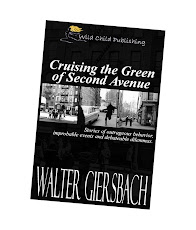
Marcel Proust immortalized the past in his recherche du temps perdu. I wrote Cruising the Green of Second Avenue to fictionalize those golden moments in 1969. In “Big Willa and a Push Toward the Edge,” published in Lunch Hour Stories shortly before the book came out, I relied on my memory to describe that “The long, sun-drenched evenings usually started with a group of us sitting on a stoop drinking beer. Maybe we’d go up to a bar. Then someone would suggest walking over to Second Avenue to get a bialy smothered in cream cheese and onions and pickled herring. Saturdays, there were demonstrations and protests to watch, but no one got involved. It was too hot, and carrying a placard was depersonalizing. Our Tar Beach was the rooftop on East Sixth Street. We'd wait until after sundown for a breath of air floating up from the river, and then, if we were lucky, we'd listen to the sounds of Country Joe and the Fish or the Fugs playing a free concert a block away in Tompkins Square. Always, there was the sound of drums echoing down the street.”
Who were the Fugs? A garage band without a garage, participants in the Peace Eye Bookstore, attendees in exorcising the Pentagon, and players of a certain amount of unexpurgated musical diarrhea. It didn’t matter what kind of diarrhea back then if you were stoned and the concert was free. For three decades I’d squirreled away a mimeographed copy of The Fugs’ song book, a treasure of the past.
Same week as the preservation story appeared in the Times a note also reported that Ed Sanders, leader of The Fugs, had written a new book. Lunch Hour Stories is out of business, but Ed’s still alive. The Fugs song book also has been preserved in the archives of the U. of Connecticut’s Babbidge Library, along with the underground comix I donated.
Time rolls on, but some things get caught in an eddy of the river. They’re preserved the way Carl Gossett’s 1969 photo of Gems Spa has been filed in the Times’ morgue. Ed is still playing with his group (http://www.thefugs.com/), whom the Voice’s Robert Christgau called “the Lower East Side’s first true underground band.”
At the conclusion of “Big Willa,” Jake says, “Willa had asked the universal question—‘You gotta hope, else, what’s left?’ And she was right. But I wish it were easier to believe in miracles and magic. That the dead will come back to life and long-lost lovers will be reunited. Instead, we go to the movies. We cheer Peter Pan. We click our heels together and bring Dorothy back to Kansas. I didn’t tell Willa that the Donnas come and go, illuminating us with a hot, bright light until they disappear into places like Atlanta. The Carolyns hit town as comic relief, and then they’re gone, too.”
If this teaser sounds interesting, send me an e-mail and I’ll send you a copy of “Big Willa.” You can also buy a download of Cruising the Green of Second Avenue at Barnes & Noble or other online retailers. And stop by Gems Spa for an egg cream.
Subscribe to:
Posts (Atom)