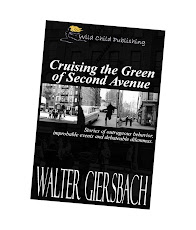
Cruising the Green of Second Avenue

Wild Child Publishing has issued the second volume of short stories in Cruising the Green of Second Avenue. The tales take up where Vol. I left off — bringing back Klein the Biker, Straight Charlie and Sammy the Madman while introducing new characters stumbling over life’s difficulties in the late 60s. Vol. II is an e-book published by Wild Child Publishing that you can download, save as a pdf (Adobe) file and print. Read both volumes and see that life isn't all that serious. Find it at Barnes & Noble, Amazon and other online book sellers.


Monday, July 22, 2013

Service in the Field of Dreams

Curt Harnack, 1927-2013

Let me say a few words in praise of a great writer and 1949 Grinnell College grad Curtis Harnack who died a few days ago at the age of 86.  I finished Harnack’s The Attic, a Memoir a while back and was deeply impressed for two reasons.  It brought back memories of my years in Iowa and it’s a well-written appreciation of the heritage that forms a person’s character.

The Iowa experience may be, as English Professor Sheldon Zitner told us back in ’60, “soft cultural primitivism”—simply nostalgia for the good old days.  Those days may not have been very good or even very old, but being at Grinnell was an academic oasis not unlike that portrayed by Herman Hesse’s fictional Magister Ludi.  Today, my life is relieved by the Internet and confounded by computer viruses, made safer by medical breakthroughs but scared into insensibility by TV commercials for spurious pharmaceuticals.  I wonder at times if I’m really ready to go into the 21st century, or whether I could go back to a softer time when the big decision meant deciding between an order of corn chowder or a pork loin sandwich.

Classmates from the ’60s would ask if I’d read Harnack, who went on to take a Master’s at Columbia, teach English at Grinnell (1952-56), and become executive director of Yaddo, the writeing colony at Saratoga Springs.  I hadn’t.  A former classmate mentioned him again last year, so I finally bought The Attic.  I’m not a great fan of memoirs, although I’ve written some. (“Tenting Tonight on the Chautauqua Circuit” appeared in The Copperfield Review, Jan. 2005, http://www.copperfieldreview.com/non_fiction/chautauqua_circuit.htm ).  The Attic, however, successfully defines and then fulfills its mission: “One writes a memoir,” Harnack writes, “to discover what recollection of a time or particular event might reveal, seeking to make the personal into something universal to which unknown readers might relate.”

The book’s form introduces the reader to his hometown and farm through the journalistic device of closing up his family’s homestead.  It devolves somewhat lengthily into an examination of relatives he grew up with—including a genealogical table—but this offers perspective from many different points of view.

There’s a third reason for my appreciating the book and author.  Harnack is the solid and memorable writer I wish I could be.  Describing “The Glorious Fourth,” he writes, “Once upon a time we citizens felt impelled to demonstrate with Fourth-of-July hoopla that America had been strong enough to make a country for itself, and the smallest popping ladyfinger suggested the shots fired at Lexington and Concord.  Now [after World War II] nobody in the world needed to be told.”

I wish I’d said that.

Friday, June 7, 2013

Flash Is Faster, or Is That a Fiction?

Author Jim Harrington asked, “Is a fast read a fast write? Isn't that what writers like about flash?" The question resolves as to whether it’s faster and easier to write a story in fewer than 1,000 words instead of a longer, more developed short story. I opt for a hearty yea. Others say no, it’s harder and slower to write succinctly when every word counts.

Start, of course, from the premise that in flash you’re only going to sketch out a character, location, time period. You must eliminate all the “decoration” and description that embellishes a short story. Can you do it?

I believe flash is easier because I’ve written short pieces for the past half dozen years. And, I come at it from a journalism background and newspaper experience. A newsie is expected to sit down (at a battered Royal, if necessary) and bang out a 30-word lede that tells the reads all the who, what, when, here and why he/she needs. (The “how” comes a few paragraphs later.)

For years, I also dedicated 30 minutes a week to a chatroom on www.Wordtrip.com called Flash Fiction Friday. A given phrase challenged any and all to write a story — long as you wanted, but taking only 30 minutes to write. Bam! Then, I’d edit it, spell check, and post it.

Going back to Wordtrip today, I was surprised to find I’d drafted 35 stories, some of them running just over 1,000 words. (You can see the original drafts at the site and my contributions as “Timberline.”) Of those 35, 30 have been published. Roughly half came in at under a thousand words.

Are they good stories? Yes. Are they literature for all times? No, often they’re genre pieces with a revelation (punch line) conclusion. Come to think of it, they’re the kind of fiction O. Henry wrote with his eye on a deadline. But you tell me. Here are the links to four of the pieces:

> “Abandoned” was published by Every Day Fiction Sept. 3, 2012 at http://www.everydayfiction.com/abandoned-by-walt-giersbach/. 

>“The Coral in Belize Is Dying” was published by Bewildering Stories Nov. 12, 2012, at http://www.bewilderingstories.com/issue502/coral.html

>“Queen at the End of the Bar” was published by Gumshoe Review on Sept. 1, 2011, at http://www.gumshoereview.com/php/Review-id.php?id=2915.

>“Million Dollar Find” was published by r.kv.r.y. quarterly June 30, 2011, at http://www.rkvryquarterly.com/?p=81

Try the 30-minute writing exercise.  At worst, you have a crappy piece of fiction.  At best, you're learned to cut through the clutter and get to the essentials of telling a story. Story prompts for fast fiction. Calisthenics for the brain.

Thursday, April 4, 2013

Doing a Solve Is Key to Writing

Might've said, "You writers are always upset about someething."


One of the epiphanies I discovered was the reveal in building my crime story to its climax.  "No," screams the grammaraian in me.  "It's the revelation in the last paragraph!"

I do try to concentrate on my characters' dialogue.  Sometimes, the PI will want to do a "solve" on the crime, instead of finding a solution.  It's like those Hollywood scripters, asking to do a lunch and a meet.

The reveal, lunch and meet — all nouns demanding a verb — are a writing/speaking function that grates on the nerves when used in real life.  They’re called nominalizations and, God help us, they’re becoming mainstream dialogue.  Nominalization is a word that’s been switched from verb into noun.  But it reads well.  It’s a “solve” to the need to sound hip.  Now, we’re stuck with these conversion formations when sequestration becomes the “sequester” on the evening news.

A friend and fellow writer says she hates "This is key."  It's one in her repertoire of writing pet peeves.  "They make me want to scream ‘one more edit!’”

Can we agree to drop the "reveals" in our flash fiction, or do a sequestration?


Monday, March 25, 2013

Were You There?

You remember matchbooks.  Those ubiquitous lighters on which detectives found scribbled clues.  The keepsake of the place where your boss gave you a promotion.  The joint where this babe kissed you for the first time, and then became your wife.

Matchbooks have disappeared.  At the Hoya resort hotel in Taitung, Taiwan, last month I asked for one and the confused clerk handed me a souvenir notebook as a consolation.  At Moriarty’s pub in Philadelphia last week, the waitress said, “I’ll give you a light, but we don’t have matches.  Or swizzle sticks.” 

Matchbooks have gone the way of celluloid mirrors (1900s), plastic telephone dialers women used to keep from breaking a fingernail (1950s), and metal lunchboxes your kids used in fights on the school bus (1960s).  We all have Bic lighters now, or have quit smoking.

Matchbooks and matchboxes are the ephemera of memories.  The Equinox in Manchester, Vt., is where Ethan Allen held staff meetings a few centuries ago.  The Kitcho on West 46th in New York was a weekly hangout for sushi when I was directing communications at Dun & Bradstreet.  The St. Regis on Fifth and 55th St. was a marvelous place to sip a martini, but don’t ask for some simple cheese and crackers for dessert.  The Hôtel Royal in Evian, France, is the place I told the roadie for my meetings to sit down and simply watch the passersby.  The Waldorf’s Bull and Bear is where my wife and I repaired for drinks before a show or after I was stuck working late.  London’s Inter-Continental brings back memories of strolling through Hyde Park.  And on and on they go.

And so the years pass.  Time is the rip tide in the Hellgate, pushing on my seventy-odd birthdays.  Surging forward and backward, dragging me onto the rocks and then washing me back with the new currents.  Why hold on to these things?  Memories. 

Realists will tell you memories are like trying to describe your first kiss with the red-headed eighth grade girl in the movie theater.  It’s not the real thing.  It’s a memory, and you can’t trust that any more than you could trust your first girlfriend.  But the truth is that the memories may be better than reality.

Monday, March 18, 2013

We're Swimming in a Digital Sea

My apologies for being away so long.  It’s unconscionable, I know, but in the meantime I’ve published four stories, a novelette of 12,000 words and several reviews.  Two more acceptances came this week and the new writing continues.

In fact, writing “in a vacuum” is on my mind.  There’s a feeling in writing camps and among other frustrated scriveners that the Web interrupts their creative juices.  Could I write in a digital vacuum?  No, never!  I can’t any longer imagine a world without Facebook, the Internet, my iPhone and Wi-Fi.  I’m not a cut-and-paste writer, but there are sources that need to be looked up, facts to be checked, names and places to be verified.

I just completed a 3,000-word story in two days this week.  It started when I stumbled across a person named Cameo.  Great metaphorical name.  What’s a cameo?  Had to look it up for the tension between black and white, smooth and rough. 

Then Sheryl Sandberg (Leaning Forward) intruded with the insight that likability and success are correlated for men, but inversely affect women.  Okay.  Good tension for a woman entering my fictional affair with a professional acquaintance.

The other main character is named Batman, like my 9th grade classmate in Pasadena.  Is there really such a name?  Yes, it’s Anglo-Saxon from Derbyshire and comes from bat, or boat.  Thank you houseofnames.com. 

I was troubled over my blah ending when my star-crossed lovers agree to see each other at the next year’s conference.  Image of a library book being returned to the lover?  Nah.  Then it came to me: the phrase signifying epiphany: “I once was lost and now am found.”  Yes!  Biblical?  No, it’s a lyric from “Amazing Grace.”  Thank you, Google.  All this research while banging out copy.

So, pooh on Yaddo and other writers’ retreats that have no Wi-Fi, little or no Internet access, that all but ban telephones.  I’m wired!  Junot Diaz wonders how many novels he will not have written because of his digital linkage.  How about you?

Monday, December 10, 2012

Gobbling Up the Whole World

Someone facetiously said that when an inveterate collector installs smoke alarms, the first one goes in the place he stores his collection.  I understand because I’m a collector without — I hope — being anally compulsive.
A few glasses from my collection of 300-plus.

I started with matchbooks in the ‘50s, especially those with Petty girl pinups.  And coins, stamps, arrowheads, junior pilot wings from airlines, and sugar packets with restaurant names as our family criss-crossed the U.S.  Now, more than ever, I relish those ephemera that have disappeared.  There were clever plastic styluses a woman used to dial a telephone without breaking a nail.  Pocket mirrors with advertising on their celluloid backs.  Toogles — the metal hooks with a faux jewel on the end women used to hang their pocketbooks on a table edge.  Other things are gone or going fast, like metal lunch boxes and fast food collectible glasses.

Collecting and the search was the basis for a short story I wrote about flea marketing (and love, with a happy ending) published in R.kv.r.y. magazine (at http://www.rkvryquarterly.com/?p=81).  My character of Archie Mezinis was “a boardwalk stroller, a country road rambler, a city street seeker.  His compulsion lay in taking an hour to walk up and down the lanes between the [flea market] tables.  His practiced eye could spot a three-inch Meissen figurine and know it was really Japanese, or a Murano cigarette time worth twice the asking price now that smoking was socially hazardous.  He didn’t sell the finds.  Instead, they went into a footlocker.  A single item in his pocket could validate his whole existence for the next week, reinforcing an existential question as to whether he was truly alive.”  Now, that’s collecting!

The value of collecting — and nature of love — were notably present in Cadillac Jack, Larry McMurtry’s haunting story.  Jack is a rodeo cowboy turned antiques scout who floats across the landscape of flea markets and auctions.  Unlike me and most collectors I know, McMurtry’s Jack was a womanizer and skirt chaser.   

Name a friend who doesn’t collect something.  At worst, it’s wanting to own one of everything in the world.  At best, it’s a desire to hold on to history.  Somewhere in between, it’s simply nostalgia.  I just don’t know where having over 300 glasses in my attic stands on the spectrum of collecting.  But you’re either part of this world — or not.  Ain’t no in-between.
 

Monday, October 1, 2012

Tempis Fugit, Write Concisely

Time slips through our fingers like (cliché warning!) sand.  Never enough of it to do all we want, especially never enough time to read. 
 
Just a reminder that Banned Books Week is Sept. 30-Oct. 6.


This is why flash fiction — generally accepted as stories of fewer than 1,000 words — is gaining in popularity.  It’s also accepted that flash is tougher to write successfully than a traditional short story.  Characters must be presented succinctly and in as few words as possible.  There is no space for meandering off into descriptions that don’t push the story line ahead.  Time is usually constricted to the immediate here and now and space is circumscribed. 

I gravitated to flash because the length and style can be applied to any genre — mystery, romance, thriller, “literary,” humor/satire, Western.  Unknowingly, I tripped innocently into writing and selling my first flash in 2007 with the sale of “Not My Wife” to the now-defunct mystery magazine Mouth Full of Bullets.  It started with my Hong Kong cop Jimmy Huang talking about a murder suspect….

Right now, I’m looking at this hwa-chiao, a Chinese-American tourist at the station house who’s bitching at Inspector Chan.  He claims he’s an important visitor.  He’s shaking his finger and saying, “I report my wife has disappeared, then I came back to find an imposter in my hotel room, not even a good duplicate.”  Of course, from his mouth it comes out like “fucking imposter” and “goddamn duplicate.”  Most perps use bad language to show their sincerity.  This guy is the slickest I’ve seen and I’ve seen a lot of them, from Guangzhou to Macao.  His missing wife was Shanghainese and one of the richest broads around.  Now he claims this woman at the hotel really isn’t his wife.

The inspiration for the story was discovering a fascinating condition known as Capgras syndrome, after the French shrink who discovered it.  It’s when you think a close relative or spouse has been replaced by an imposter, an exact double.  (Send me an e-mail if you’d like to know how Detective Huang solved the murder in 744 words.)

Since that time five years ago, I’ve written and published, in print and online, some 36 flash fiction pieces.  Half a dozen of them have appeared in one of the great online publications, Every Day Fiction.  You can read “Death in the Afternoon,” one of my early sales, at http://www.everydayfiction.com/death-in-the-afternoon-by-walter-giersbach/. 

Best part of writing for immediate gratification is that I trip over loads of prompts.  “Number Eleven” concentrated on the terrible coincidence of the number of letters in a phrase or name; “Fifty Ways to Leave Your Lover” by Paul Simon made me think of a 51st event that might have won the Darwin award for stupidity; “Queen at the End of the Bar” (http://www.gumshoereview.com/php/Review-id.php?id=2915) was inspired by pollution causing biological changes in wildlife (and humans?); and “Where’s Old Bill Hughes” was prompted by a mythical passenger who has survived shipwrecks for 200 years. 

Now, someone help me with a story surrounding prosopagnosia, the neurological condition in which person doesn’t recognize faces.  I have a touch of that bad wiring in my brain, and can’t come up with a plot.